If You’re Staying on Oracle EBS, You’re Not Being Left Behind
Part 1 of a three-part series on staying with Oracle E-Business Suite. Part 2 offers a way to check whether the products around you are still being invested in. Part 3 looks at what to do with the runway.
Look at almost any enterprise software roadmap right now and it points in one direction. Cloud.
And running right alongside it, AI. Almost every vendor has an AI story, every keynote has an AI segment, and a good deal of it is genuinely interesting. But notice where most of the newest investment is being delivered: in cloud products. So the two messages arrive together and reinforce each other. Cloud is where we’re going, and AI is what you’ll get when you’re there.
That’s fine if you’re going there. Plenty of organizations are, and for good reasons. But plenty aren’t, and some genuinely can’t. If that’s you, the volume of the messaging can start to feel less like a strategy and more like a nudge. Or a shove.
You are not behind. Here’s why.
Plenty of EBS Environments Are Working Exactly as Intended
There’s a version of this conversation that treats staying put as inertia. It usually isn’t.
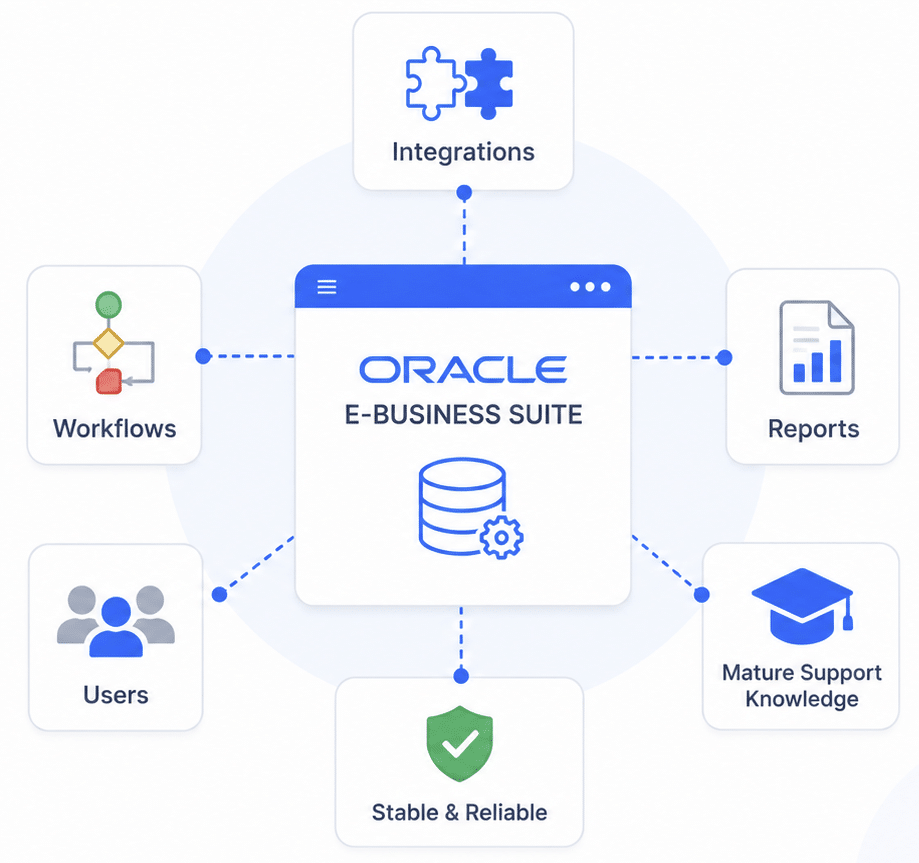
Organizations that stay on Oracle E-Business Suite have typically spent 10, 15, 20 years shaping it around how the business actually runs: the customizations, the integrations, the reports, the workflows, the interfaces out to the warehouse and the bank and the tax engine. That accumulated fit isn’t technical debt by default. Very often it’s the reason month-end close lands on time.
Then there are the people. Your functional team knows the system cold, your users know where everything is, and your support process is mature. That institutional knowledge has real value, and it’s the first thing a migration spends.
So if your EBS environment supports the business, your users are productive, and your run costs are predictable, “we’re staying” is a perfectly rational answer. It doesn’t need defending.
And Some Organizations Genuinely Cannot Move
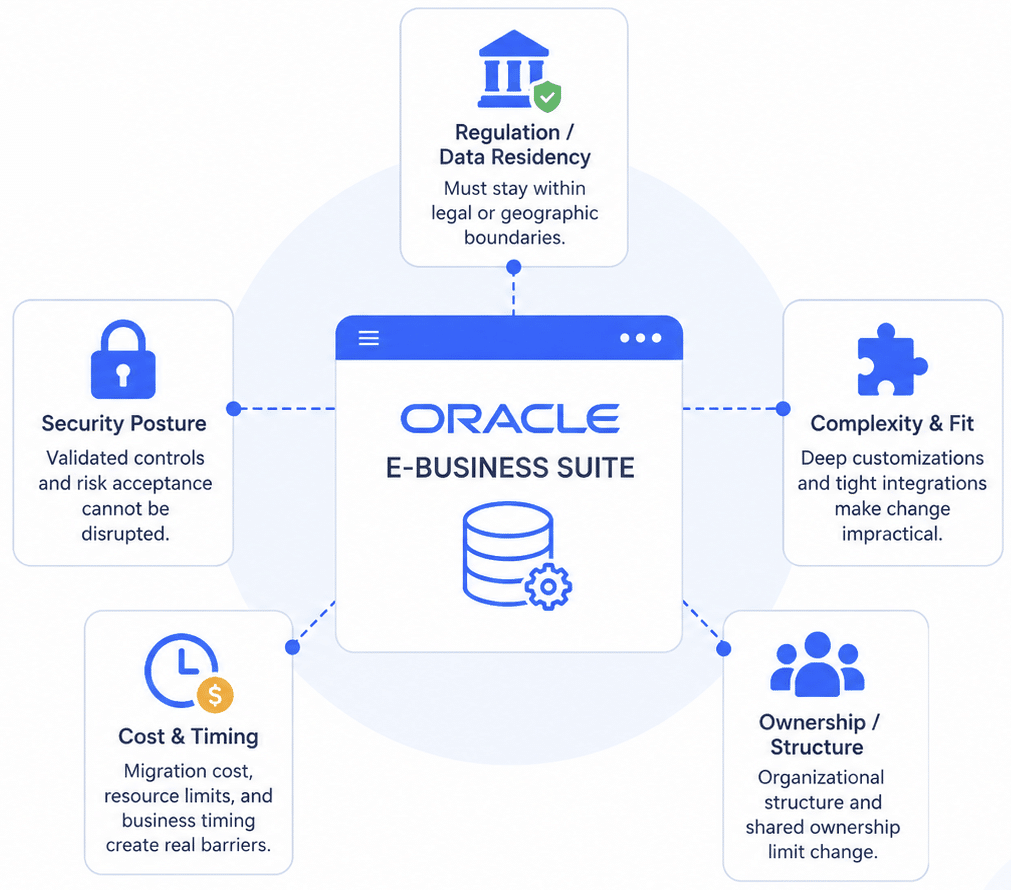
Beyond preference, there are organizations for whom a move to a pure cloud application simply isn’t practical today. The reasons we hear most:
Regulation and data residency. Requirements around where data can reside, who can access it, and which jurisdictions are acceptable can materially constrain cloud choices, and in some environments rule particular SaaS models out entirely.
Security posture. Some defense, government, utility, and critical infrastructure environments operate on isolated or heavily restricted networks. If the application cannot reach the internet, a cloud application may simply not be an option.
Complexity and fit. Heavy customization, deep integration, and industry-specific processes that a standard cloud application does not cover in the same way. Some of those gaps close over time. Some do not close on your timeline.
Cost and timing. A migration competes with every other major program you have. Sometimes the business case simply doesn’t clear, and pretending otherwise doesn’t make it clear.
Ownership and structure. Pending acquisitions, divestments, joint ventures, or private equity ownership can freeze major platform decisions for years at a time.
None of these are excuses. They’re constraints, and they’re real.
Oracle Has Already Settled the Support Question
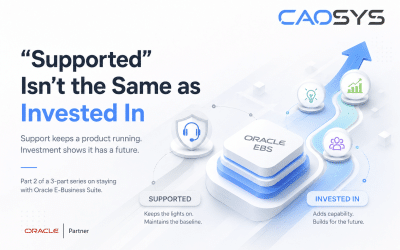
This is the part that gets lost in the noise. Under Applications Unlimited, Oracle has confirmed Premier Support for Oracle E-Business Suite 12.2 through at least 2037. That’s not Sustaining Support and it isn’t a holding pattern. Oracle continues to support, develop, and enhance EBS under its Continuous Innovation model, with more than a decade of runway from where you’re standing today.
If you run EBS, that should take any artificial support deadline off the table. Whether and when you move to cloud becomes a business decision you make on your own timing, with a proper case behind it, rather than a deadline you’re running from.
The Pressure Isn’t Coming From Oracle
Let’s be fair about this. Oracle is investing heavily in its cloud applications and promoting them hard, and you’d expect nothing else. That’s where much of the company’s growth sits, and you’ll see it at every event and in every keynote.
But promoting cloud and abandoning EBS are two very different things, and Oracle has been careful not to confuse them. Applications Unlimited is the commitment, and the Premier Support dates are what that commitment looks like in practice. Oracle is making the case for cloud while continuing to support and develop the thing you’re already running. Nobody is being forced off EBS before they’re ready, or before they’re able.
Across parts of the third-party market, the pattern is different. Vendors naturally follow growth, and much of that growth is in cloud, so development effort has shifted with it. In some cases the EBS product remains supported, but the roadmap becomes quieter, releases become more maintenance-focused, and the newest capability appears somewhere you can’t use it.
Nobody announces this. You just notice, eventually, that the release notes have got thinner and the roadmap slide has stopped mentioning you.
That’s what can create the pressure to move before you’re ready. Not Oracle’s roadmap. The shrinking supply of people still building for where you actually are.
A Tooling Gap Is Not a Reason to Move a Platform
Nowhere does this land harder than internal controls.
Oracle’s own GRC line for EBS, made up of Application Access Controls Governor, Configuration Controls Governor, Preventive Controls Governor, and Transaction Controls Governor, moved to Sustaining Support, with the special provision of Severity 1 fixes ending in May 2025 under Oracle’s Lifetime Support Policy.
Meanwhile the control bar has gone up, not down. SOX obligations haven’t softened, and in the UK, Provision 29 of the 2024 Corporate Governance Code now applies to financial years beginning on or after January 1, 2026. Boards have to show their working through the year, not assemble it at year end.
And the work itself doesn’t get any smaller while you wait. A single user holds several responsibilities (roles), each responsibility exposes a menu structure nested several layers deep, each of those exposes individual functions, and the request group behind it exposes concurrent programs that carry plenty of capability of their own. Test that population against a meaningful ruleset and you’re into numbers no spreadsheet is going to help you with. This is precisely the kind of work that needs tooling.
So many EBS organizations are sitting in a similar spot: important control processes still depend on tooling that is no longer being actively developed. And one answer increasingly put in front of them is to solve the problem as part of a wider move to cloud. That may well be the right answer for some organizations, but it shouldn’t be the only one on the table.
Re-platforming a working ERP because you need segregation-of-duties analysis is letting a tooling decision drive a strategy decision. It should be the other way around. Fix the control gap where you are, then decide about cloud, later, on the merits.
What We’re Doing About It
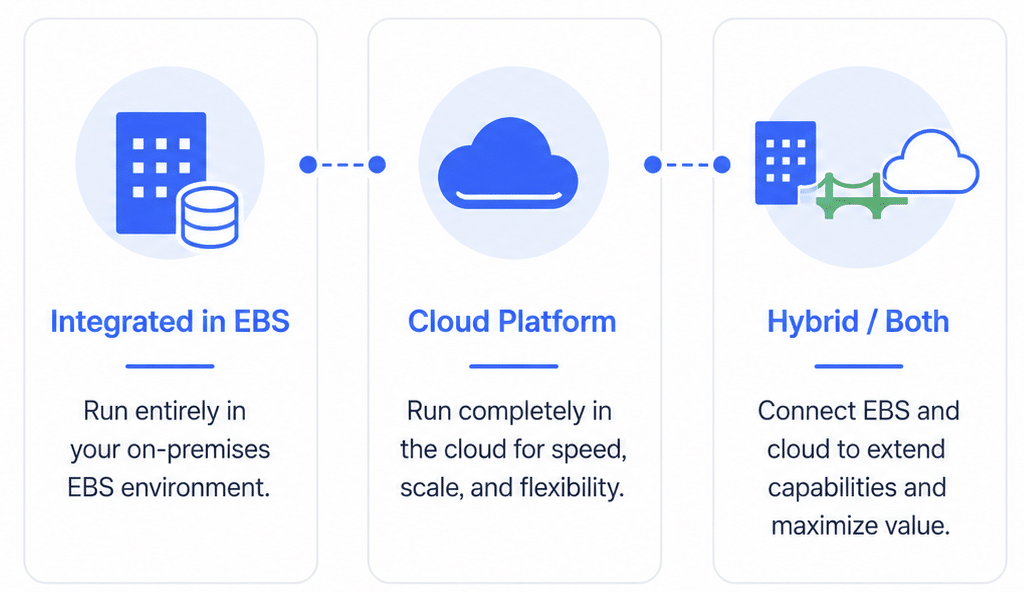
CAOSYS has been focused on the Oracle ecosystem since 1999, more than 25 years. Our integrated suite installs directly into Oracle E-Business Suite, wherever you run it, on premise or in Oracle Cloud Infrastructure. There’s no separate server, appliance, or middleware to stand up, and the products operate within the EBS environment. Because they’re installed inside EBS, they can be brought into the same backup, cloning, and disaster recovery processes you already use to protect EBS itself.
We continue to develop that suite. Not maintain it, develop it. We keep it aligned with supported EBS releases and we keep adding capability, in step with Oracle’s own commitment to the platform. If you’re running EBS into the 2030s, we intend to be right there with you.
The suite covers the core control and reporting work EBS teams actually have to do:
- CS Comply: segregation of duties and sensitive access, including preventive control at the point access is granted.
- CS Audit: real-time auditing and monitoring, capturing who, when, and what, with a full before-and-after picture of the change.
- CS Impact and CS Lookback: configuration comparison between two points in time or two environments, and a broad retrospective sweep across the database when you need to know who has been transacting where.
- CS Provisum PAR: periodic user access review (UAR) with an evidenced, closed-loop process.
- CS Report: interactive operational reporting and practical mini-applications inside EBS, built without a traditional development project.
Together that covers the questions we keep coming back to: what can they do, what did they do, do they still need it, and what’s actually going on in the data. All of it inside EBS.
If You’re on Cloud, Heading There, or Running Both
CAOSYS also runs the CAOSYS Cloud Platform, providing cloud-delivered access risk and user access review capability across Oracle ERP Cloud (Fusion) and Oracle EBS, through CS Shield and CS Access Review.
So the choice between integrated and cloud isn’t a statement about which platform we believe in. We actively develop both. If you run EBS, the integrated suite is there for you. If you run Oracle ERP Cloud, the cloud platform is there for you. And if you run both, which plenty of organizations do, the two sit alongside each other perfectly well: integrated inside EBS, cloud across Fusion, one supplier and one conversation.
Cloud is not “the future of CAOSYS” with EBS as the legacy tail behind it. Both are current, both get investment, and both have a roadmap. Pick the one that matches where you run.
The Quiet Part
Most of the market’s attention has moved toward cloud-first tooling, and we’re not aware of another vendor still building this range of control and reporting capability to run inside Oracle E-Business Suite itself. That’s an odd thing to find yourself saying about a platform with well over a decade of committed support ahead of it.
We haven’t stayed here out of nostalgia. We’ve stayed because a large number of organizations are still running EBS, they’ll be running it for a long time yet, and they still need this work done properly. Meeting them where they already are seems like the obvious thing to do.
Oracle is continuing to invest in the platform. We’re continuing to invest in the controls and reporting around it.
If you’re staying on Oracle EBS, that’s a legitimate strategy, not a delay. You should be able to run modern, defensible, audit-ready controls without being told to change platform first.
Contact Steve Davis at steve.davis@caosys.com or connect with him on LinkedIn.