“Supported” Isn’t the Same as Invested In
Part 2 of a three-part series on staying with Oracle E-Business Suite. Part 1 made the case that staying is a legitimate strategy rather than a delay.
You ask a vendor when a particular capability is coming, and the answer is vague in a way it never used to be.
Nothing is wrong. The product still works, support tickets still get answered, the renewal still lands on time. Nobody has announced anything. But you put the phone down knowing something has changed, and you can’t point at what.
That feeling is often right, and it’s worth taking seriously. The trouble is that the contract won’t confirm it for you.
So this piece is about how to check.
What “Supported” Actually Tells You, and What It Doesn’t
Start with what the words actually mean, because they get used loosely.
Oracle’s own model is a useful reference, since it’s the one most EBS teams already know.
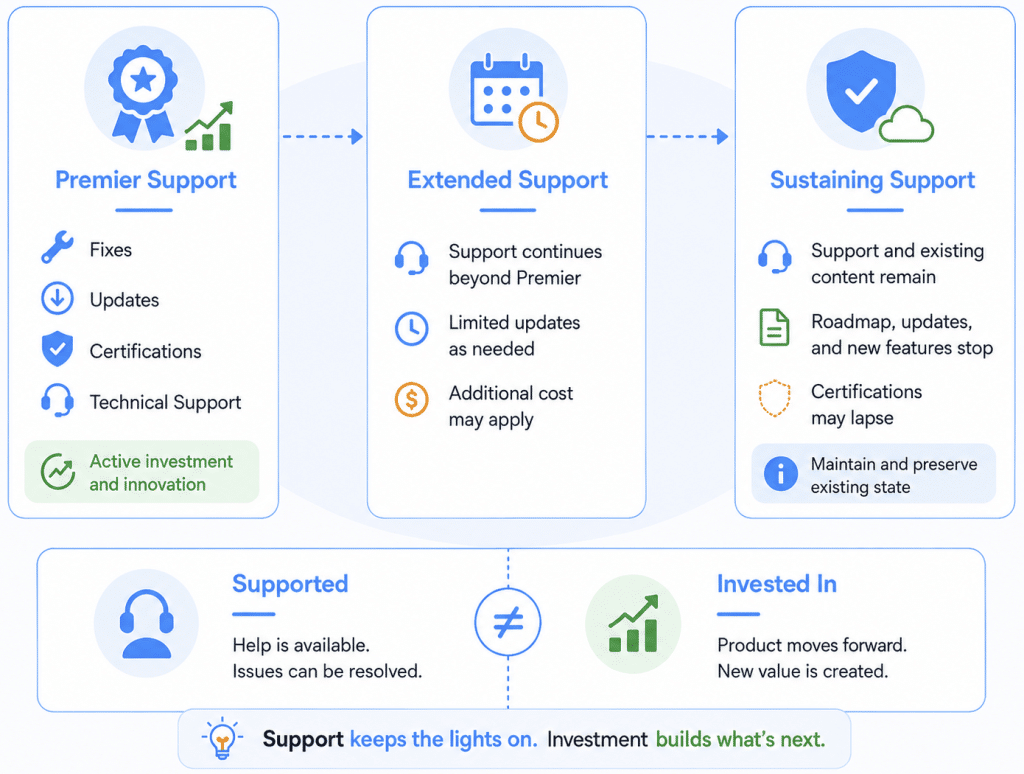
Premier Support is the full support offering: fixes, updates, certifications, and technical assistance. For EBS 12.2 under Oracle’s Continuous Innovation model, it also sits alongside continued product enhancement and new capability.
Extended Support continues elements of that support beyond the Premier period for products where Oracle offers it, typically for an additional fee.
Sustaining Support is different again. You keep access to the product, technical support, and what already exists, but the product is no longer moving forward in the same way. New fixes, new updates, and new certifications are generally no longer being produced. Sustaining Support is a product being kept available, not a product being taken forward.
Now the part that matters more, because it applies to every vendor in your estate and not just Oracle. Even full, top-tier support tells you only that someone is committed to supporting the product. It doesn’t tell you whether anyone is still investing in it.
A product can be entirely supported and going absolutely nowhere. Those are different states, they can look identical on a contract, and only one of them has a future.
It helps to have an example of what the other state looks like in practice. In June 2026, Oracle published an FAQ setting out its plans for the Next Generation Technology Stack for EBS 12.2: the move from today’s Classic Technology Stack to Oracle Fusion Middleware 14c, WebLogic Server 14c, Forms and Reports 14c, HTTP Server 14c, and Java 17. It covers planned certifications and roadmap information, preparation requirements, readiness utilities, the potential impact on customizations, and new tooling to automate the update. Oracle also makes the point that adopting it won’t require an EBS upgrade, because the update is designed to use 12.2 Online Patching and can be applied while functional users stay online. (Update: EBS 12.2 Application Technology Stack Roadmap, Oracle E-Business Suite Technology blog, June 9, 2026.)
Set aside the detail for a moment and look at the shape of it: a named future stack, a published path to reach it, tools built to help you get there, and visible thought given to what adopting it will cost you. That’s what active investment looks like when it’s written down.
Now hold that up against the third-party products in your estate.
This Happens Without Anyone Behaving Badly
It’s worth being fair about how a product ends up in that position, because it’s rarely a decision anyone announced.
Vendors follow growth. Much of the growth and new investment in enterprise software is concentrated in cloud products, so that’s where the engineers, roadmap sessions, and marketing budget tend to go. The EBS product doesn’t get cancelled. It gets a smaller team, then a more maintenance-focused release cycle, then a slot on the roadmap slide that eventually stops being filled in.
Nobody sat in a meeting and decided to leave you behind. The priorities just moved, gradually, and you weren’t in the room.
That’s ordinary commercial behavior, and it’s exactly why waiting for an announcement is the wrong strategy. There usually isn’t one.
Eight Questions to Ask About Every Third-Party Product in Your EBS Estate
Here’s the practical bit. Take your list of third-party products running against EBS and put each one through the same eight questions.
It doesn’t need to become a major exercise. Half a day will get most teams a useful first pass.
1. When did this product last gain something, as opposed to fix something?
Separate enhancement from maintenance. Bug fixes and patches are the vendor meeting an obligation; new capability is the vendor still investing.
If you can’t remember the last time a release gave you something you didn’t have before, that tells you something.
2. Is it certified against the EBS version you’re actually running, and how fast did that arrive?
Certification lag is one of the clearest signals available. A vendor still actively investing in EBS should be able to explain how and when they validate support for new releases. Long, unexplained delays are worth asking about.
3. Is there a published roadmap, and does EBS appear on it?
Not “is there a roadmap.” Does your platform appear on it, by name, with something specific next to it?
Absence is information.
4. What has happened to release cadence over the last three years?
Look at the actual release dates rather than the marketing around them. Cadence tends to stretch quietly before anything else changes, and it’s easy to miss when you’re only paying attention at renewal.
5. Who answers your tickets now, and has the quality of the answers changed?
Support quality often changes when product knowledge gets thinner. You’ll usually feel it before anyone says it explicitly: more escalations, slower answers, more responses that simply restate the documentation.
6. Where does the vendor’s own marketing point?
Look at their homepage rather than your account manager. Where does the case study section sit? What does the webinar schedule cover? What did they talk about at their last user event?
Vendors are honest about their priorities in public, mostly because they’re not thinking about you when they write it.
7. If you raised an enhancement request today, what would you honestly expect?
A release, or a polite “we’ll feed that back to product management.” You probably already know which.
The point is to write it down.
8. How exposed would you be if this product never changed again?
This is the question that turns a list into a decision. Some products can sit frozen indefinitely without costing you anything. Others sit underneath a control that gets tested every year.
Rank them.
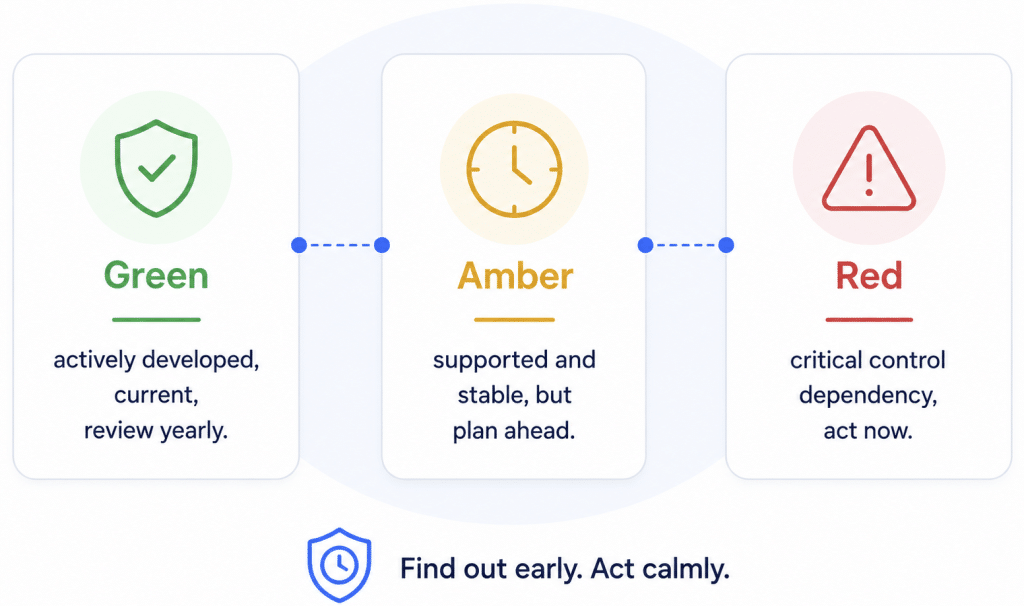
A simple red, amber, green view across your estate fits on one page, and one page is what gets taken into a leadership meeting.
What You Do With the Answers
Green. Actively developed, current certifications, EBS visible on the roadmap. Nothing to do beyond revisiting it once a year.
Amber. Supported, stable, fit for purpose, but no longer really moving forward. This is where many frozen products actually sit, and it isn’t an emergency. It’s a planning item.
You now know the product has a finite life, so you can plan the replacement on your timeline, with a proper evaluation, at a point that suits your budget cycle. That’s a very different exercise from replacing something in a hurry because it broke or because an auditor forced the issue.
Red. A product that has stopped moving and sits underneath something you’re accountable for. Access controls. Audit trails. Access review evidence.
This one deserves active attention. The relevant clock may be your next audit, your next EBS upgrade, or the next change in the control requirement, rather than the vendor’s formal support date.
One thing to be clear about, since Part 1 spent its whole length arguing against being rushed. This exercise isn’t a reason to panic, and amber isn’t a crisis. The entire point of doing it deliberately is that you find out early enough to act calmly. Organizations get forced into rushed decisions because they discover the problem at the worst possible moment, not because the problem was unsolvable.
Ask Us the Same Eight Questions
It would be a poor article that handed you a questionnaire and then quietly excluded the people who wrote it. So run it on CAOSYS.
We’ve been building for the Oracle ecosystem since 1999. Our integrated suite, including CS Comply, CS Audit, CS Impact, CS Lookback, CS Provisum PAR, and CS Report, installs directly into Oracle E-Business Suite and continues to be developed rather than simply maintained.
EBS appears on our roadmap by name. New capability continues to arrive alongside fixes and compatibility updates. Enhancement requests are still being considered by teams actively developing those products. And when you look at what we talk about publicly, EBS is plainly still there, alongside our cloud platform rather than behind it.
Ask us for specifics on any of the eight. If a vendor can’t answer question 1 or question 3 without changing the subject, that tells you something, and that applies to us as much as anyone.
The Vendors Worth Keeping
The awkward thing about this checklist is that it isn’t really about catching anyone out. It’s about knowing what you have, so that the decisions ahead of you are ones you choose rather than ones you’re handed.
You will probably find that most of your estate is fine, one or two products are quietly amber, and possibly one is somewhere you’d rather it wasn’t. That’s a useful exercise either way.
And the vendors genuinely still with you are the ones who’d be pleased you asked.
Part 3 looks at what to do with that runway: where to invest, what to replace, and what is perfectly safe to leave alone.
If you’d like to put these questions to us directly, get in touch. We’d rather have that conversation than not. Contact Steve Davis at steve.davis@caosys.com, connect with him on LinkedIn.