In our last article we explored why businesses should adopt the highest levels of risk management when it comes business critical systems like their ERP system. We were left with the daunting challenge that ERP systems by their nature and importance to a business, demand the highest levels of risk management and that high level of management can mean significant conflict management if you delve to the deepest depths.
And on that basis, now we have a better understanding of risk and why risk should always be mitigated (or remediated) as much as possible, what do we mean when it comes to risk management of Oracle E-Business Suite or Oracle Fusion Cloud ERP? In general terms, it is the pro-active control of potential conflicting elements such as responsibilities and functions in EBS or roles and privileges in Cloud ERP, and then the on-going maintenance of the resulting ‘internal control framework’ to ensure that it remains robust, compliant and auditable at all times.
And there has never been a time when this could not be more important.
With many EBS customers having invested their faith (and money/resource) and the management of that internal control framework in Oracle’s own GRC solution, they now find themselves in somewhat of a pickle. With that Oracle GRC solution moving to Sustaining Support as of May 2025, they find themselves needing to find an alternative, and quickly. In short, Sustaining Support equals ‘end-of-life’, with no updates, critical patch fixes and, significantly, no regulatory updates.
This leaves those EBS customers who have been using Oracle GRC with three options. The first option, although viable, is to cross fingers and carry-on using Oracle GRC, but it’s risky. Additionally, Oracle GRC licences are often linked to EBS licencing, so more EBS licences could mean spending more on an obsolete product!
The second option is to revert to manual reports and spreadsheets but surely the reason for adopting Oracle GRC in the first place was to move away from resource absorbing, error prone processes that are ultimately ineffective. An approach that often means significant auditing hours when it comes to audit time!
And the third option is to look for an appropriate third-party tool that can do everything that AACG or CCG or EGRCM or TCG or PCG, could ever do. But with the ever-present thrust from software developers towards Fusion Cloud ERP, sadly a suitable solution for EBS customers is becoming as rare as hen’s teeth.
And let’s not forget, to create a meaningful risk management framework, you really need to be granular when it comes to looking for conflicts. It’s not just looking at responsibilities/roles in isolation, but you need to look at the function level (including concurrent programs), access through menus, direct user access and consider all the permutations of everything combined together. Add in things like collusion related risk and combating false positives and you quickly realise that no-mere human can hope to manage all of this without major help.
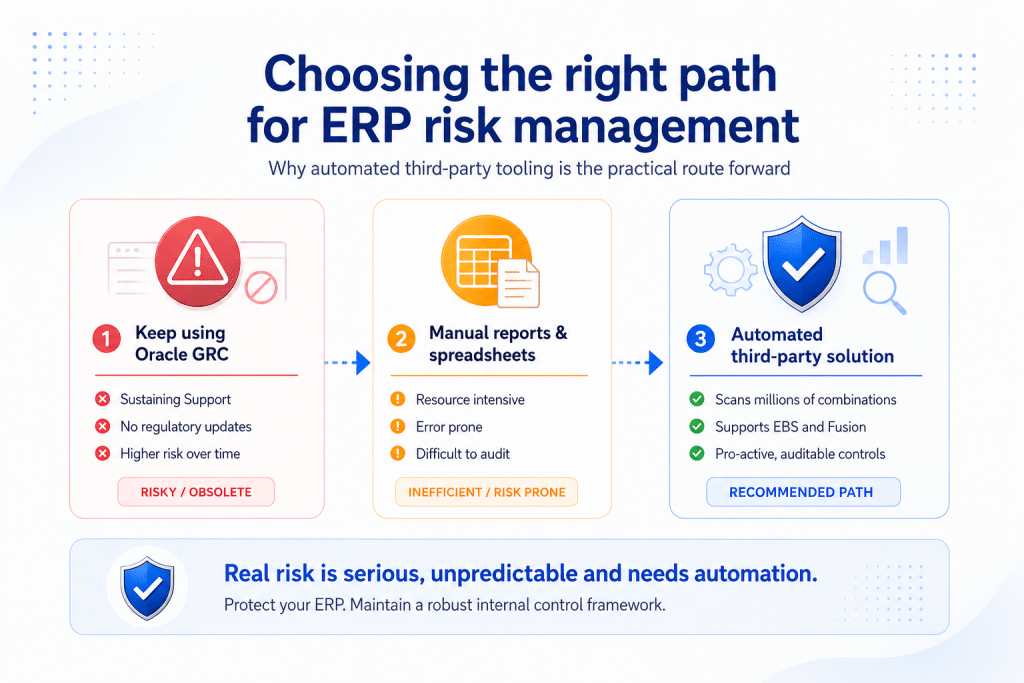
All things considered, with Oracle GRC heading off into the distance and the manual approach being unwieldy and error prone, it then becomes obvious that a third-party tool is the only real option. One that has the ability to automate the pro-active management of risk and is capable of scanning for conflicts over millions of possible combinations.
But, as has become all too apparent in my recent travels, there are still a few users that are still in a state of flux and stuck with option one where they are ‘making do’ with the current system or falling back on option two and manual processes until they can find the help they need.
With an ERP system being central to the success of any business, protection of that system becomes paramount. Risk is not perceived, it is real, it is serious and, moreover, it is unpredictable, so a clear and certain path forward is vital.
With no apology, with a strong commitment to support EBS customers through their compliance and auditing requirements and with an impressive list of global clients, CAOSYS is perfectly placed to deliver a fully integrated solution suite that really is one of those ‘hen’s teeth’.
Originally published in November 2025 in conjunction with the Autumn Series of webinars.