Operational Reporting: The Missing Layer in Many Oracle EBS Environments
Oracle E-Business Suite runs an extraordinary amount of a company’s daily operations: purchasing, payables, receivables, inventory, HR, and more. All of that activity generates data people need to see, right now, in a form they can actually use. That is exactly where most Oracle EBS environments have a gap.
Call it operational reporting: the reports and screens people need just to run the business day to day. Not a year-end financial statement, just the practical, recurring questions a team asks constantly. Which invoices are on hold? What’s overdue for receipt? Who’s been granted access this month? Standard EBS reports exist, but they’re built for general use, and general use doesn’t always match the specific question a particular user or team has on a given day. That leaves a gap between the data sitting in EBS and the answer someone actually needs.
That gap doesn’t stay still, either. As people get more comfortable in Oracle EBS, they tend to get resourceful, piecing an answer together from two or three existing screens because that’s the closest thing available. It works, for a while. But the next question needs a slightly different combination of the same data, then the next one after that. Operational reporting needs don’t really settle down over time. They keep evolving as people find new ways of working with what’s already there.
What operational reporting actually needs
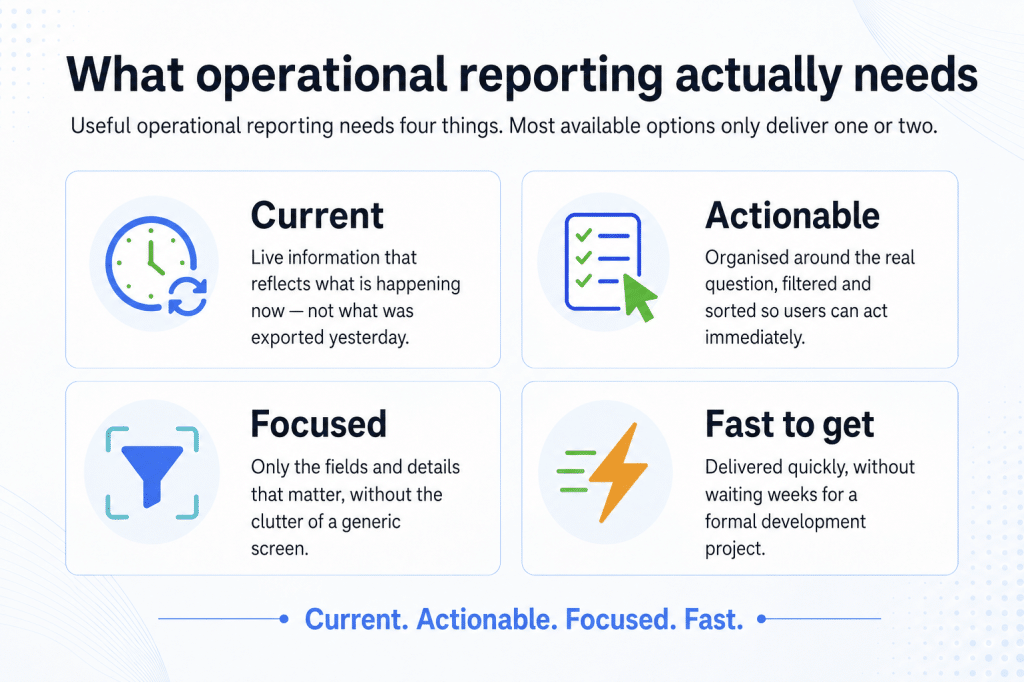
In practice, useful operational reporting needs four things. Most of what’s readily available to Oracle EBS customers only really delivers one or two.
Current
A report is only useful if it reflects what’s happening now, not what happened when someone last exported it. A spreadsheet built this morning is already stale by this afternoon, and the same is true of a report living in a tool outside Oracle EBS: if the data behind it was exported or synced yesterday, or last week, it’s only ever as current as that last extract, however polished the tool itself might be.
Actionable
The data needs to be organized around the actual question, filtered and sorted the way the person doing the work thinks, not handed over as a generic export that still needs shaping before anyone can use it.
Focused
Standard EBS screens are built to serve everyone, so many carry fields and options that have nothing to do with the question in front of you. That breadth is useful when you need it, and clutter when you don’t. Hunting for the three fields that matter among twenty that don’t slows people down and makes a report harder to trust at a glance.
Fast to get
None of this matters if getting it takes weeks. Most day-to-day reporting needs don’t justify a formal development project, but that’s often the only route left once a standard report falls short.
Why the gap exists
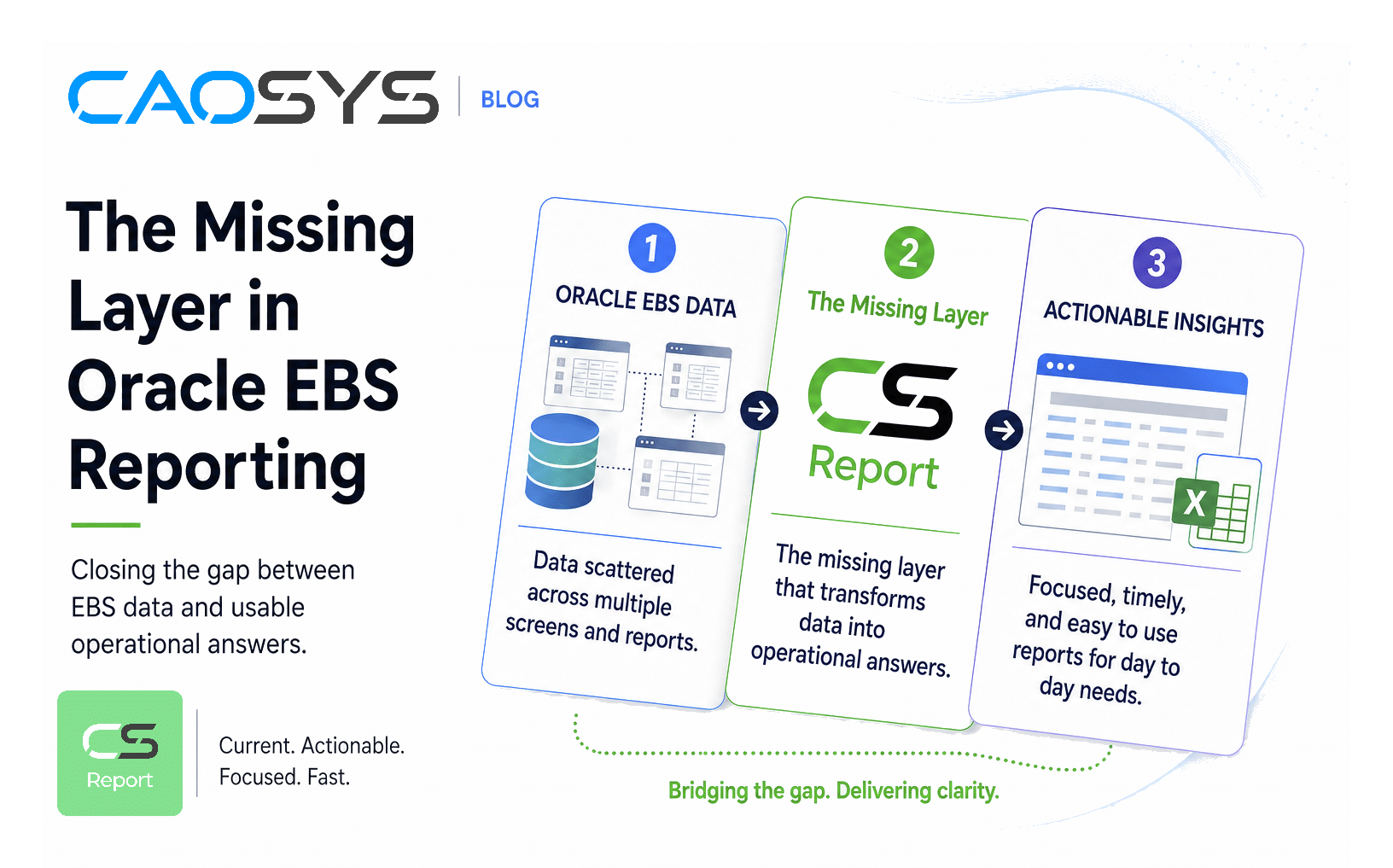
This isn’t really anyone’s fault. Most reporting options for Oracle EBS sit at one of two extremes: a fixed, standard report built for general use, or a full custom development project built for one very specific need. Very little sits in between, built quickly, tailored to the actual question, and kept live inside the system where the data already lives. That’s the missing layer.
Where CS Report fits
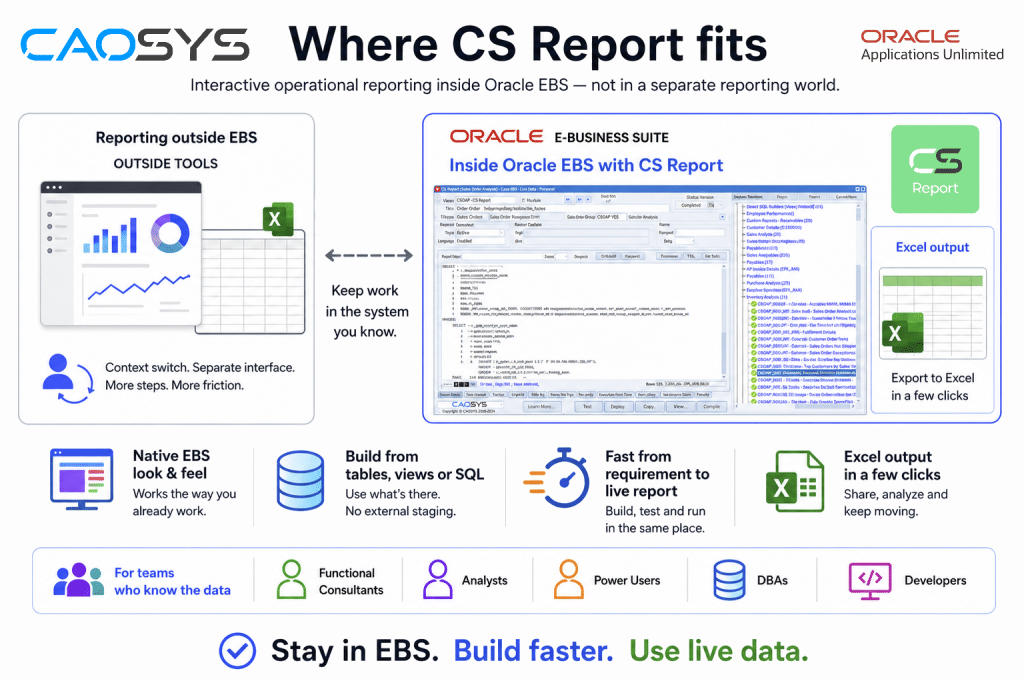
This is exactly the space CS Report is built for, starting with where it lives. Reporting tools that sit outside Oracle EBS ask users to learn a second interface and work in an environment that doesn’t look or feel like the system they use for everything else. That switching cost is real: it slows people down and makes a tool less likely to be properly adopted, however good the reporting underneath it might be.
CS Report keeps people exactly where they already work. It lets you create your own on-screen, interactive reports inside Oracle EBS itself, with the same look and feel as the standard EBS forms, built around exactly what one team or one job needs rather than a generic screen meant for everyone.
A report is built by pointing CS Report at the table or view behind the data, or by providing a SQL statement, so it helps to know your way around the data. But you don’t need to be a developer to do it. It’s used effectively by functional consultants, functional analysts, process owners, power users, and DBAs, anyone comfortable with basic SQL. In the hands of an actual developer it’s more powerful still, because the same speed from idea to deployed report simply goes further. Either way, a report can go from requirement to something live and usable in a fraction of the time a custom build would take, and once built, it stays live: refreshed automatically, a click or two from Excel whenever that’s what’s needed.
The layer, filled
Current, actionable, focused, and fast to get: that’s the layer usually missing between the data in Oracle EBS and the person who needs an answer from it, delivered inside the system they already know, without waiting on a development queue or rebuilding the same spreadsheet every month.
And operational reporting turns out to be just the start of what a layer like this can do inside Oracle EBS. But that’s a subject for another day.
For more information about how CS Report can help you satisfy your operational reporting requirements and save you time and money, get in touch with Steve Davis at steve.davis@caosys.com, or schedule a live demonstration here.