In our last post, we set out three questions every Oracle EBS controls team has to answer: who can do what, what did they actually do, and do they still need it. This post takes the first one and goes a bit deeper.
Access risk in Oracle EBS comes in two flavours, and both deserve equal attention.
The first is Segregation of Duties (SoD): making sure no single person controls two steps of a process that, combined, let them do something harmful. The second is Sensitive Access (SA): a single capability powerful enough to be a risk on its own, no second step required. Teams often focus heavily on the first and treat the second as an afterthought. That’s a mistake. A single person with the wrong sensitive access can do just as much damage as any duty conflict.
Why This Is Harder Than It Sounds
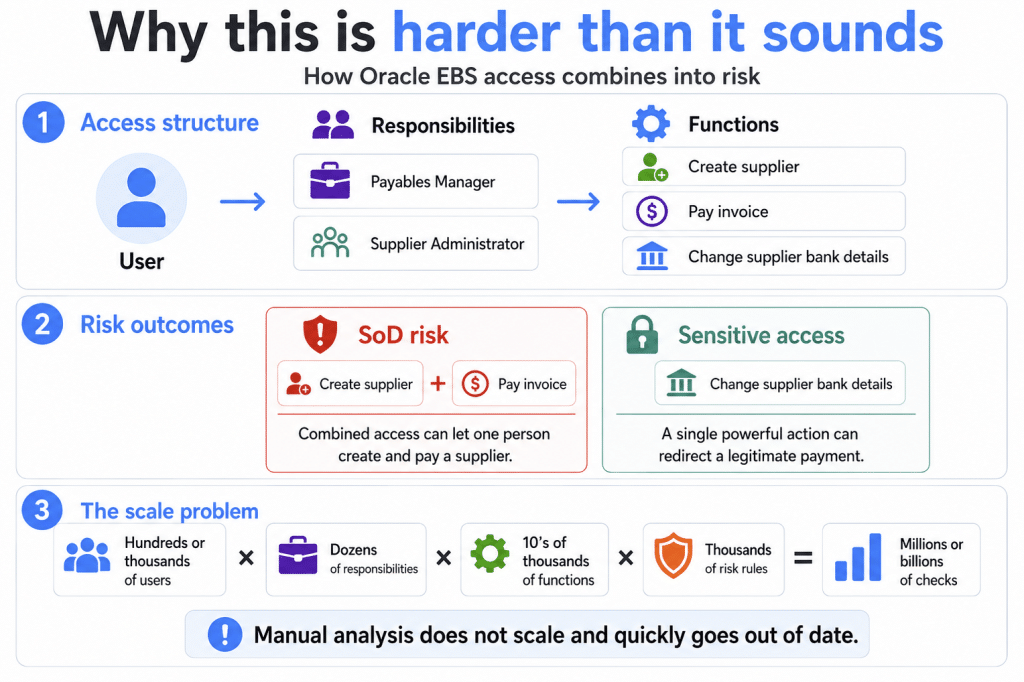
In EBS, access isn’t a single switch. Users hold responsibilities, and each responsibility exposes a set of functions (and concurrent programs), the specific screens and actions a user can actually perform. Most people hold several responsibilities at once (sometimes hundreds), often overlapping. So the real question isn’t “does this user have the supplier form?” It’s “across everything this user holds, do the underlying functions combine into something risky?” And you have to ask that for every user, against every combination you care about.
Here’s a concrete version of it. Suppose one person can both create a supplier and enter and pay an invoice. On their own, each task is perfectly normal. Together, that one person can set up a fictitious supplier and pay it, with no second pair of eyes to stop them. It’s one of the most common fraud patterns in accounts payable, and exactly the kind of combination SoD analysis exists to catch.
Sensitive access is a quieter risk, but no smaller. Changing a supplier’s bank details is a one-person action that can redirect a legitimate payment to a fraudster. Nobody sets out to hand fifty people that capability. It usually just comes bundled inside a broad responsibility that was assigned for an entirely different reason.
Here’s why that’s harder than it sounds to do by hand. Even a modest EBS environment might have a few hundred users, each holding a number of responsibilities, each of those exposing hundreds or thousands of functions. Multiply those together and you’re already into millions of individual access points, before you’ve tested a single one against a risk rule. Add a realistic set of rules on top, and the number of checks climbs a long way past that. No spreadsheet keeps up, and it’s stale the moment access changes, which in a live system is constantly.
Why It Matters Right Now
This isn’t just good practice. It’s what regulators expect you to evidence. In the US, Sarbanes-Oxley has long required companies to demonstrate effective segregation of duties and control over sensitive access as part of internal controls over financial reporting. In the UK, Provision 29 of the Corporate Governance Code asks boards to make an annual declaration on the effectiveness of their material controls, with the first cycle landing in 2026.
But regulation isn’t the only reason to take this seriously.
Access risk also isn’t just a finance problem, even though the accounts payable example is the classic one. The same pattern shows up in procurement, HR, supply chain, system administration, wherever EBS grants meaningful capability. And it’s a bigger driver of loss than most people assume. The Association of Certified Fraud Examiners’ 2024 global fraud study found that just over half of all cases involved either a lack of internal controls or controls that existed but were overridden.
How CS Comply Helps
This is what CS Comply is built for. It ships with 500+ risk rules out of the box, covering both segregation of duties and sensitive access, and a scanning engine that’s exceptionally fast at hunting down, identifying, and summarizing risk across every user and every access point. You get the full lifecycle in one place: report the risk, remediate it, and document it for your auditors.
One capability worth calling out specifically: because CS Comply installs directly inside EBS, it can work preventively, stopping a risky combination from being granted in the first place, not just flagging it after the fact. That’s something a cloud-only tool, working on data brought in after the fact, simply can’t do.
Worth being honest about too: no tool removes the need for judgment. CS Comply gives you visibility and the means to act on it, but deciding what’s genuinely risky for your business, and what’s an acceptable exception, is still a human call. The tool’s job is to make sure that call is an informed one, made on complete information, not a guess.
Next up, we’ll look at the second question: what did they actually do. Even with access risk under control, you still need a defensible audit trail of what changed in your system, and why.
Want to see what a first scan for SoD conflicts and sensitive access might turn up in your environment? Get in touch with Steve Davis at steve.davis@caosys.com, or schedule a live demonstration here.