Just to be clear, “Bovvered” is informal British slang that means someone is not concerned or bothered about something, a term made famous by British comedian Catherine Tate. It is often used in a sarcastic or dismissive way. So not really a term you might want to use when it comes to risk management on your Oracle E-Business system.
And yet, far too many private companies genuinely don’t seem to be overly bovvered to make sure they have a watertight risk management and internal controls framework in place. Unlike a listed company, private companies aren’t normally bound by any mandatory regulations that demand oversight and the associated reporting at Board level. And, surprisingly, with the new trend of private equity firms buying public and then taking them private, because the bottom line is the only priority, it’s things that hit the bottom line and don’t generate income, that are first to get the chop!
Even if controls are implemented or retained, often you find that it’s the bare minimum, a tick in the box, with fingers crossed that the company could escape any significant untoward damage. And even if it does all go wrong, as it would be considered a ‘private’ matter, any reputation damage can be kept out of the public eye. But you have to ask, is it really worth the risk?
What about Private Companies?
Private companies are just as vulnerable to unscrupulous behaviour as listed companies and serious fraud can destroy a company, be it large, medium or small and be it listed OR private. And yes, the private equity trend is about reoccurring revenues and profits, but normally the ultimate goal is to resell or re-float, and surely an effective risk management and internal control framework can only add inherent value when it comes to those next steps (and prove to buyers or stock markets, that governance has been taken seriously).
So private companies REALLY do need to take this Segregation of Duties and Sensitive Access stuff seriously, make the budget available (and appropriate) and put the project time aside to do something about it. It could well be argued that getting it right, could guarantee the future of a company, whatever direction that future might take. It isn’t just spending money for the sake of it, it’s actually the best, if not the perfect, approach to doing business (and your customers and business partners will respect that).
Recently, we have had a perfect example of the approach outlined above with one of our customers when they were de-listed and taken private by a private equity firm. Sadly, the first thing that happened after the takeover was the internal audit team was reduced to one person AND the investment in automated risk management was cut. With the sole internal auditor now facing a mountain of manual work, would it not have made common sense to increase automation to maintain adequate levels of risk management. When the time comes, not having a proper risk management and internal control framework could impact a successful re-float or sale.
But why is automation so important, even with a fully resourced internal controls team? Let’s just say your organisation has just 10 Oracle EBS users and you are looking for just a single “risk” where one person can create suppliers and invoices. You’d take a quick look at what each of the 10 users can do within the system and check for conflicts. Where they are found you would then remediate the risk. All very simple you might say.
A prohibitive numbers game!
However, what if we are talking more than a single risk. Imagine you have lots of potential risks that need to be checked (with our CAOSYS solutions we provide a risk matrix of over 10,000 potential risks/rules). Still possible to do manually but extremely labour-intensive and prone to error. When you start to talk numbers like this, the biggest issue faced can be the sheer volume of data that is often involved.
To put things into perspective, let us look at what could be a typical mid-range company. The company runs Oracle EBS with 1,000 users that have 425 distinct roles/responsibilities, and average of 10 responsibilities per user and an average of 125 menu entries/functions per responsibility. If we multiply the users by the average number of responsibilities and then the average number of menu entries, then we could be looking at 1,250,000 entry points into the system!
But this is based on a single rule. If we consider there might be 10,000 rules to evaluate, then we could be looking at 12,500,000,000 checks for conflict. In fact, for some of our larger customers, the number of theoretical tests that would need to be performed runs into the 100’s of billions and even trillions.
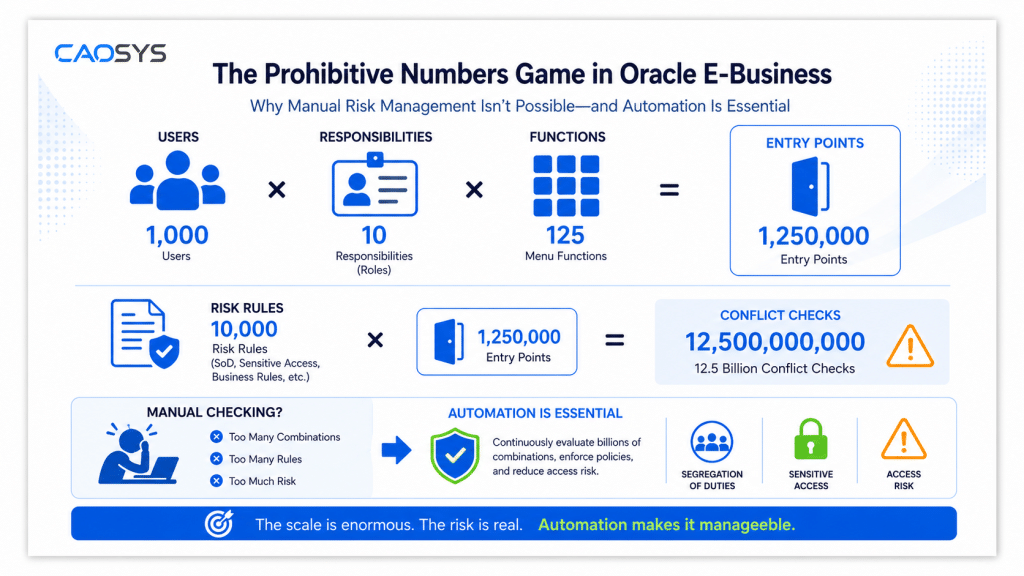
So how would you approach this if you were asked to manually figure out where the access risks are in your system? The answer is, you wouldn’t because it is impossible without the help of some sort of software automation.
When it comes to private companies, the challenges they face managing risk is exactly the same as for listed companies, there just isn’t the mandatory legislative oversight to force them to effectively address those challenges. Sometimes you’ll find the internal audit team (or person) is held accountable for all levels of audit reporting and risk management, all be it often with reduced resource and lack of funding for automation. And when something slips through the net, they become the ‘fall guy’. The advantage private companies do have is that, should anything major go wrong, it can be fixed without the publicity that a listed company might otherwise attract.
But it should be pointed out that not all private companies are the same and some are very much bovvered by risk management and internal controls. So much so, that it is surprising that other private companies don’t follow their lead instead of trying to cut corners just to make those revenue figures look a little better.