Life After Oracle GRC: Moving Beyond AACG, PCG, CCG and TCG
If you run governance and controls on Oracle E-Business Suite, you have probably known this was coming for a while. Oracle GRC, Oracle’s former governance and controls suite for EBS, has reached the end of its active product life.
Oracle GRC, made up of Application Access Controls Governor (AACG), Preventive Controls Governor (PCG), Configuration Controls Governor (CCG) and Transaction Controls Governor (TCG), has moved to Sustaining Support. Under Oracle’s published support policy, the additional provision of Severity 1 fixes during Sustaining Support ended in May 2025.
Meanwhile, EBS itself is going nowhere. Oracle has confirmed Premier Support for Oracle E-Business Suite 12.2 through at least 2037. You are therefore left with a core business platform supported for well over another decade, while the governance tooling that once helped control it is no longer being developed.
The obvious question is what you should do about it.
This article is about answering that calmly, without panic and without being pushed somewhere you do not want to go.
What “Sustaining Support” Actually Means
Sustaining Support does not switch the software off. Oracle GRC can continue running, and it may be tempting to leave it alone because nothing has visibly broken.
The problem is what stops.
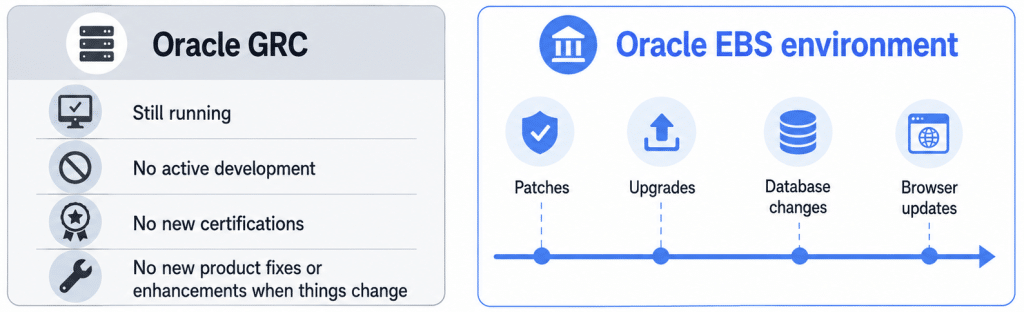
The software is no longer being actively developed or newly certified alongside the EBS technology stack it is intended to govern. Oracle technical support does not simply disappear, and customers retain access to existing fixes and assistance. What you can no longer rely on is a new product fix, certification or enhancement being produced when circumstances change.
The risk is rarely a dramatic failure tomorrow. It is gradual drift.
Your EBS environment continues to evolve through patches, upgrades, database changes and browser updates, while the governance tooling remains where it was. If an incompatibility or product defect eventually emerges, support may be able to diagnose it or point you towards an existing solution, but there may be no new fix coming.
Continuing to run is not the same as having a dependable long-term control platform. If important SOX or UK Corporate Governance Code control processes rely on Oracle GRC, it is sensible to consider how those processes will remain supportable, testable and resilient throughout the remaining life of EBS.
Separate the Product from the Job It Was Doing
When a product reaches this stage of its life, the instinct is often to search for a like-for-like replacement.
A more useful starting point is to ask what Oracle GRC was actually doing for you.
Strip away the product names and it performed several well-defined jobs: analysing access and segregation-of-duties risk, preventing certain risks before they materialised, controlling changes to important configurations, and identifying transactions or activity that matched defined risk conditions.
The product may have stopped developing, but the underlying risks have not disappeared. Organisations still need appropriate controls and reliable evidence for whichever of those risks are material to them.
That is the real starting point for life after Oracle GRC.
It Is About the Questions, Not a Feature-by-Feature Swap
There is a temptation to line up AACG, PCG, CCG and TCG against a replacement suite and search for an exact match for every feature.
That is rarely the best way to approach the decision.
Different products organise controls in different ways. A replacement may approach some requirements differently, while also addressing important areas that Oracle GRC did not cover particularly well, or did not cover at all.
The better question is whether you can continue answering the control questions that matter to your organisation.
For most EBS controls teams, those questions fall into three broad areas.
Who Can Do What?
This is the access-risk question: segregation of duties, sensitive access and the practical activities a user can perform through their assigned access.
CS Comply provides that visibility across Oracle EBS, tracing access through to the functions and concurrent programs users can execute. It can identify risky combinations and sensitive capabilities, while applying preventive control at the point access is requested or granted.
This is prevention where it has the greatest effect: reducing the likelihood that inappropriate access enters the environment in the first place.
What Changed, and Who Changed It?
Access tells you what someone could do. It does not tell you what they actually changed.
CS Audit records monitored changes as they occur, capturing who made the change, when it happened and what changed, with a full before-and-after picture and real-time notifications.
CS Lookback provides a broad retrospective view of who has added or updated data across EBS without requiring the relevant items to have been selected for monitoring in advance.
CS Impact adds another perspective by showing how important configurations have changed over time or how they differ between environments.
Together, these capabilities help organisations establish accountability for change: not simply collecting raw audit data, but turning it into information that can be investigated, understood and used as evidence.
Do They Still Need It?
This is the question that often remains unanswered even when access risk was properly assessed at the point access was granted.
People change roles. Responsibilities accumulate. Temporary access becomes permanent. Access that was appropriate twelve months ago may no longer have a valid business purpose.
Oracle GRC could provide information that supported access analysis, but it did not offer the same purpose-built, end-to-end access-review campaign and certification workflow available in modern user access review tools.
CS Provisum PAR is designed specifically for periodic access reviews. It gives managers and process owners an evidenced workflow for reviewing access, recording decisions and driving the removal of access that is no longer required.
This closes an important gap between analysing access risk and periodically confirming that the access people hold is still justified.
Moving Beyond Oracle GRC Without Recreating It
Being straightforward, the CAOSYS integrated suite is not intended to be a screen-for-screen recreation of Oracle GRC.
It does not need to be.
What matters is that the key control outcomes most organisations depended on, including understanding access risk, preventing inappropriate access, monitoring important change, establishing accountability and reviewing whether access remains necessary, can all be addressed.
There may be individual Oracle GRC controls that need to be approached differently. That is why a transition should begin with the risks and control objectives, rather than with a simple comparison of product menus.
In many cases, organisations may also find that the new approach extends beyond what they previously had, particularly in areas such as dedicated user access review, real-time change notification and broader accountability for activity across EBS.
Do You Have to Move to the Cloud?
For many teams, this is the real concern.
The message from much of the market is that the answer to every EBS question is to move to the cloud, and GRC is no exception.
For a large number of organisations, that is not immediately realistic or desirable, whether because of regulation, data sovereignty, security, complexity, cost or the level of investment already made in EBS.
Plenty of businesses will continue running EBS for many years, exactly as Oracle’s support commitment through at least 2037 allows.
The reassuring part is that you do not have to move to the cloud to modernise your GRC capabilities.
The CAOSYS integrated suite installs directly into Oracle EBS, whether EBS is operated on premises or hosted on Oracle Cloud Infrastructure. It meets you where your EBS environment already runs rather than requiring you to move the underlying application.
For organisations seeking a cloud-delivered approach across Oracle Cloud ERP or EBS, CAOSYS also offers CS Shield and CS Access Review.
The deployment model is a choice, not a condition.
How to Approach the Move
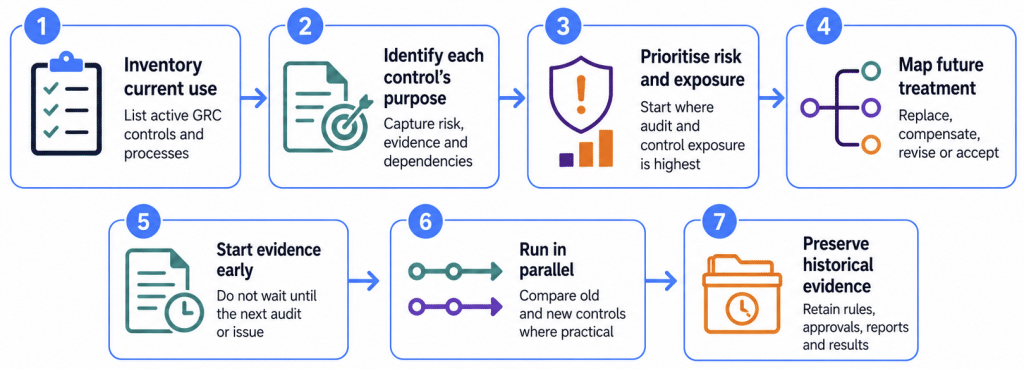
You do not need to select or buy anything to make a sensible start. A few practical steps can provide a much clearer picture of what comes next.
1. Inventory what you use today
List the Oracle GRC controls, rules and processes your organisation actively relies upon. Separate what is genuinely used from what merely exists in the system.
2. Identify the purpose of each control
Record the risk each control addresses, the evidence it produces and the audit or operational process that depends on it.
This is more useful than documenting features alone because it reveals the outcome that must be preserved.
3. Prioritise by risk and exposure
For many organisations, access risk, segregation of duties and sensitive access will be an early priority because they are highly visible, frequently material and difficult (often near impossible) to manage consistently by hand.
Your own order should reflect your risks, audit scope and existing compensating controls.
4. Map each requirement to its future treatment
Decide whether each requirement will be addressed by a replacement control, an existing compensating control, a revised business process or an explicitly accepted risk.
This prevents less important legacy features from distracting attention from the controls that genuinely matter.
5. Do not wait for something to break
Continuous evidence can be difficult, and sometimes impossible, to reconstruct reliably after the event.
Where monitoring or audit evidence is important, begin collecting it before the old control is removed rather than waiting until the next audit or investigation.
6. Run old and new controls in parallel where practical
A period of parallel operation allows you to compare results, confirm coverage and resolve differences without creating a gap in control.
7. Preserve your historical evidence
Before Oracle GRC is decommissioned, determine which historical results, rules, approvals and reports must be retained for audit, investigation or regulatory purposes.
The goal is not simply to replace the software. It is to maintain continuity of control and evidence throughout the transition.
Where CAOSYS Fits
CAOSYS has worked within the Oracle applications ecosystem since 1999, and its integrated suite is particularly well suited to organisations planning for life after Oracle GRC while remaining on EBS.
The suite addresses the control areas many organisations rely on most: access risk, segregation of duties, sensitive access, auditing and monitoring, accountability for change, configuration comparison and periodic access review.
It remains actively developed and aligned with supported Oracle EBS releases, so organisations are not moving from one static platform to another.
Because the integrated products are installed within the EBS environment, they can be incorporated into the same backup, cloning and disaster-recovery processes used to protect EBS itself.
Their direct integration also means that relevant controls and workflows can operate within the application environment, rather than depending entirely on an external platform and a subsequent integration to complete the process.
The objective is not to recreate Oracle GRC for its own sake. It is to preserve and improve the controls that matter while giving your organisation a supportable path forward.
Move beyond Oracle GRC, without leaving EBS.
If you are mapping your route away from Oracle GRC, we would be glad to talk it through, without pressure or a predetermined answer.
Get in touch, or ask us for a short demonstration of CS Comply, CS Audit or CS Provisum PAR.
Contact Steve Davis at steve.davis@caosys.com, connect with him on LinkedIn, or schedule a live demonstration.