Oracle EBS Is Here to Stay, so Should Your Reporting Strategy
For years, the assumption around Oracle E-Business Suite has been that it’s living on borrowed time: a platform organizations are gradually being nudged off, sooner or later, toward the cloud. Oracle’s own numbers say otherwise.
In March 2026, Oracle confirmed Premier Support for Oracle E-Business Suite 12.2 through at least 2037. That’s under Oracle’s Applications Unlimited strategy, its long-standing commitment to keep investing in a handful of established on-premise product lines rather than forcing every customer onto a single cloud timetable. EBS sits alongside JD Edwards EnterpriseOne, PeopleSoft, and Siebel under that same umbrella. For EBS specifically, the commitment runs through what Oracle calls Continuous Innovation: ongoing updates and new capability delivered into 12.2 itself, without requiring customers to jump to a whole new release to get them.
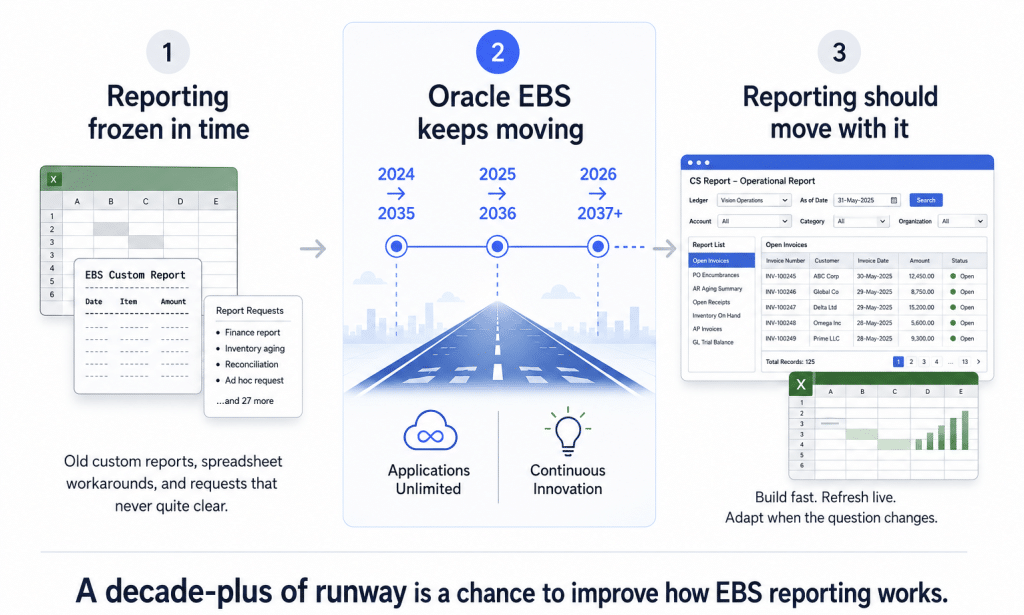
It isn’t a one-off promise, either. Oracle has extended Premier Support for EBS 12.2 close to every year since first naming it the long-term support release back in 2018, and in recent years each extension has kept the horizon at around ten to eleven years out from the year of the announcement: 2035 announced in 2024, 2036 in 2025, and now 2037 in 2026. That’s less a single fixed cutoff and more a rolling window that keeps moving forward as Oracle keeps renewing it.
If you’re one of those customers, that changes the question. It’s no longer “how long do we have left on EBS.” It’s “what are we going to do with the decade-plus we’ve got.” And for a lot of organizations, the honest answer, at least when it comes to how people actually get useful information out of the system day to day, is: not much has changed in years.
The reporting approach nobody’s revisited
Plenty of Oracle EBS environments are running a reporting and productivity setup that was put together years ago and hasn’t really been looked at since. A handful of custom reports built during the original implementation. A folder of spreadsheet macros someone built, that only they fully understand. A standing request list to IT that never quite clears. None of it was wrong when it was built. It’s simply been standing still while everything else has kept moving, including Oracle’s own investment in the platform underneath it.
That gap tends to widen quietly rather than dramatically. Nobody wakes up one day and decides to freeze their reporting approach. It happens because the original setup worked well enough, priorities moved on to other things, and revisiting “how we get reports out of EBS” never quite makes it to the top of anyone’s list. A decade is a long time for a gap like that to sit unattended.
What about a dedicated reporting tool?
Some organizations go a different route and license a proper external reporting or BI tool: rich dashboards, polished visualizations, real analytical depth. Fair enough. Most of these tools are genuinely very good at what they do.
But they sit outside Oracle EBS by nature, and that brings two problems that are easy to underestimate. First, it’s a different interface entirely, one that doesn’t look or behave like the EBS screens people already use for everything else, so there’s a second system to learn and get comfortable with. Second, the data usually isn’t live. Either the tool connects into EBS through some kind of interface or connector, or, more often, it relies on a periodic extract and upload, refreshed on a schedule rather than reflecting what’s actually happening in EBS right now.
None of that makes these tools bad. It just means they’re built for a different job: executive dashboards, trend analysis, board-level reporting. That’s not quite the same job as the in-the-trenches operational reporting this piece is about, the “which invoices are on hold right now” kind of question, and a tool built for one doesn’t automatically fit the other.
A platform still moving deserves tooling that moves with it
Oracle isn’t standing still with EBS. Continuous Innovation means new capability keeps arriving inside 12.2 itself, not just security patches, and the rolling extensions mean that’s been true for years and shows every sign of staying true. A reporting and productivity strategy that’s been frozen since go-live doesn’t really fit alongside a platform still being actively developed.
This is the case for treating operational reporting as something you keep investing in, not something you solved once. Reports that are fast to build and deploy today matter just as much next year, when the question changes again. Screens that feel native to EBS today should still feel native in five years, not stitched onto a system that’s since moved on around them.
It’s also the thinking behind why CAOSYS keeps actively developing CS Report for the integrated suite, in step with Oracle’s own roadmap for EBS. If Oracle is committed to this platform for the long term, the tools built on top of it should be too. Nobody wants to invest years of reporting and process work into a solution that quietly stops evolving.
Oracle renews its EBS commitment a year at a time rather than promising everything upfront, and CS Report works the same way on a much smaller scale. A report gets built and deployed in minutes, not weeks, and rebuilt again the moment the next question comes along, rather than locked in for good the day it’s first built.
The takeaway
Oracle just gave Oracle EBS customers a decade-plus of runway. What you do with your reporting strategy over that time is entirely up to you, but “leave it as it is” is a choice, not a default. Worth treating it like one.
Curious what an actively evolving operational reporting layer for Oracle EBS could look like for your team? Get in touch with Steve Davis at steve.davis@caosys.com, or schedule a live demonstration here.