Operational reporting, built inside Oracle EBS. Same look and feel. No developer required.
You know exactly the report you need. You can picture it: the columns, the filters, the grouping that would finally make the numbers make sense. Oracle E-Business Suite won’t give it to you like that out of the box, so you raise a request with IT.
And then you wait.
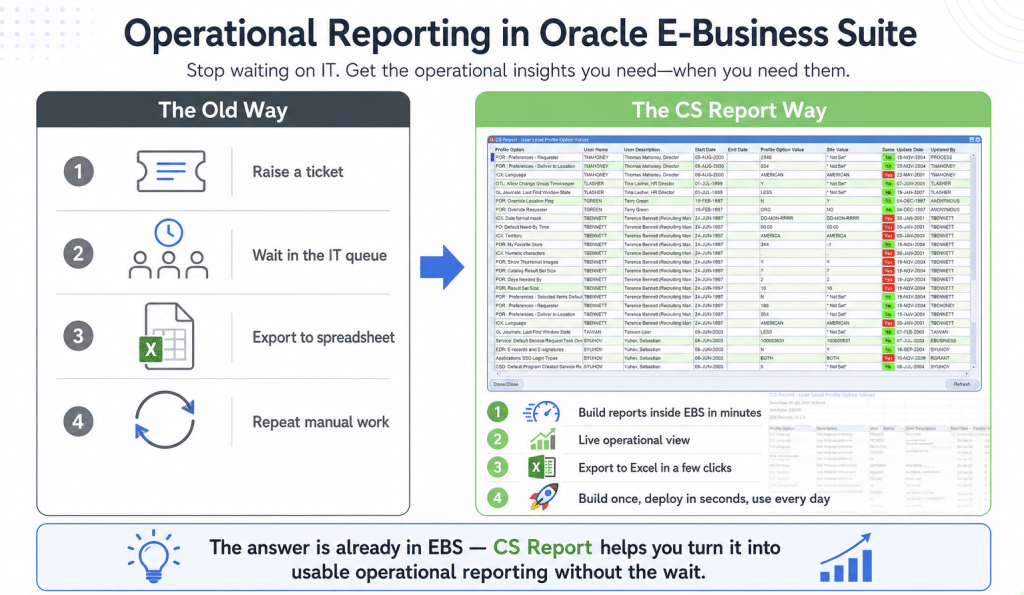
It’s nobody’s fault, exactly. Standard EBS reports are built for general use, not for the specific question you have today. Anything beyond them means development: a spec, a developer, testing, a migration through environments, and a place in a queue behind a dozen other priorities. A report you can describe in an afternoon can take weeks to appear.
By the time it lands, the moment has usually passed and the month-end you needed it for is long gone. Or you gave up waiting and built it by hand: a raw export dropped into a spreadsheet, then sorted, colored, and stitched back together every single time you need it. It works, just about. But you’re doing it again next week, and the week after that.
And plenty of reports never get built at all. They aren’t worth a development request on their own, so they simply don’t happen, even though they’d save someone real time every day.
Some reporting genuinely needs IT – most doesn’t
To be fair, some reporting does belong with a development team: enterprise-wide analytics, data warehousing, anything that reaches well beyond EBS. That’s real development work, and it should be treated that way.
But it isn’t what most people are waiting on. Most of the time you just need a clear, current view of data that already lives in EBS: invoices on hold and why, open purchase orders by buyer, who has which responsibilities, whatever your team needs to act on. That shouldn’t need a developer. And it shouldn’t need you to haul the data out of EBS to get it.
Build the report yourself – inside EBS
There’s no shortage of reporting tools that work with Oracle EBS. But most sit outside it: you extract the data into a separate product, learn a separate interface, and run another system alongside EBS. Fine for big-picture analytics. Rarely the best fit for the in-the-trenches operational reports people need day to day, where you want the answer where you already work, in a form that feels familiar.
This is where CS Report is different. It lets you build your own on-screen, interactive reports inside Oracle EBS, with the same look and feel as the standard EBS forms, so they feel native, because they are. No developer required. Building a report is quick, deploying it takes a few clicks, and sending the results to Excel takes a few more.
Take a common one. Your AP team needs to stay on top of invoices on hold: which invoice, which supplier, how much, what the hold is, who needs to act. In standard EBS that means hopping between forms and piecing it together every time. With CS Report you build one screen that shows exactly that: filtered to what matters, sorted the way your team actually thinks, live from EBS, and a click from Excel when someone wants it in a meeting. Built once, used every day. No ticket, no wait.
The point – the answer is already in EBS
The data you need is already sitting in Oracle EBS. Getting it into a usable shape shouldn’t hinge on someone else’s backlog. When the people who understand the question can build the report themselves, safely, in the system they already use, the queue shrinks, the answers arrive sooner, and IT gets its time back for the work that genuinely needs it.
And reporting is only the start. Once you can build a screen this way, you can go further and build small, EBS-native screens that let people do things, not just view them. But that’s for another post.
For more information about how CS Report can help you satisfy your operational reporting requirements and save you time and money, get in touch with Steve Davis at steve.davis@caosys.com, or schedule a live demonstration here.