We all know the story of the Grinch and how, because he had a grudge with Whoville, he decided to ruin Christmas for the townsfolk. Only in the famous Dr Seuss story, he has a crisis of conscience and returns all the presents and sets about righting his wrong.
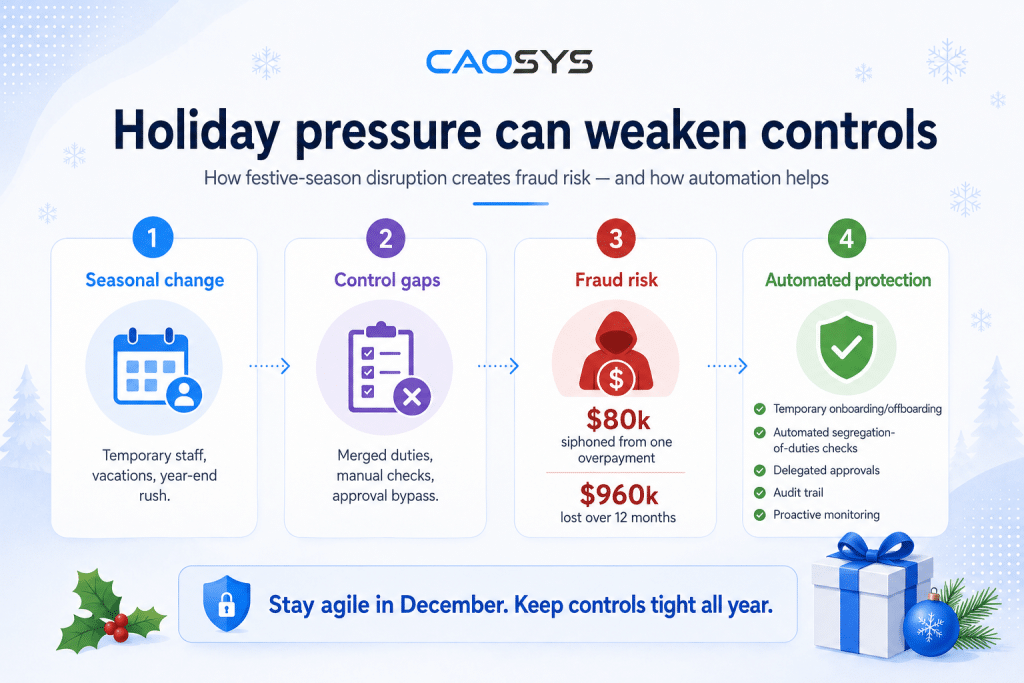
Sadly, in the real world, there are all too many Grinch’s that set out to capitalise on the festive season, and none of them have a conscience! It is a time of year when some companies go through significant short-term changes like the need to staff up because of increased demand, the need to merge job functions whilst people take extended vacation, the all-important year end accounting and freezing of systems. All this can have a whirlwind effect on processes and procedures that work steadily at all other times of the year.
And it is this whirlwind of change that presents opportunity to fraudsters as people take their eye off the ball and think of Santa (and of course the season starts early in the US with Thanksgiving at the end of November).
At a time when there is pressure on maintaining Segregation of Duties as additional staff are temporarily onboarded, it is all too easy to allocate responsibilities and roles without the normal granular checking for conflicts. It doesn’t help that occasionally, due to staff vacation, the responsibility for those checks falls to someone who doesn’t normally do them. All of this is not helped if SoD is being managed manually.
A perfect example of this, and the company shall remain anonymous, featured a manager working in a finance department that was responsible for final validation of all payments related to company projects. Compliance controls demanded that no payment could be made without a triple check that meant any information input on the system was verified and then authorised by different people before payment.
Unfortunately, an error was made when paying a supplier for the first time, the amount being $1.78m when the correct amount was $1.70m. The supplier immediately picked this up and reported the overpayment to the manager. But, due to it being Christmas, the lack of authorised staff members meant the manager had the ability to circumvent all three levels of the triple check. And he saw his opportunity.
He permitted payment instructions for $1.78m to be raised and, although the payments were automated, the final step to generate the SWIFT transfer was manual. At this point he changed the SWIFT transfer to the correct amount and syphoned off the ‘extra’ $80k into an account in the British Virgin Islands. With the controls now bypassed, during the next 12-months the manager managed to defraud his company to the tune of $960k!
The fraud was only discovered because the following December the manager had a car accident which saw him hospitalised. Without him in the loop to redirect funds, the supplier reported another overpayment which then led to the discovery of the original error and so the fraud unwound. And all because it was Christmas and compliance controls were compromised due to lack of staff.
The money was never recovered.
Without doubt, more than at any other time, it’s December that can present the biggest challenges to compliance. A large upturn in business transactions means it is easier for fraudulent activity to get ‘lost in the fog’, coupled with an urgency to get things done before the holidays kick in. And the holidays themselves can be a major distraction to keeping your ‘eye on the ball’.
So just when there is a need to be acutely vigilant due to the hive of activity, often there simply isn’t the resource or will to cope. But having the need for agility, and yet still maintain tight security controls, can be achieved with the use of third-party solutions to address the issue. By using such solutions to automate your compliance processes and, more importantly, the checks and sums that ensure the integrity of your internal control framework, you can reduce the reliance on available resource and maintain a high level of oversight.
As standard, such tools should deliver the ability to temporally on-board employees and check for functional conflicts, and then off-board them as required, removing all traces of access from the system. Where there is a ‘triple check, a robust approval process should exist that automatically defers approval at different levels, with no one individual owning more than one approval and automatic delegation. And, for instance, where Segregation of Duties need to be merged because of vacation, then these need to be automatically revoked when normality resumes and all with a clear audit trail of what was done and by whom and when during the given period. Throw in a dash of pro-active monitoring of risk, and you can enjoy December knowing that there are no backdoors left open simply due to the season.
If you want to know more about how CAOSYS automated compliance solutions can make your Christmas a happy one, email steve.davis@caosys.com for more information.