What Did They Actually Do? Auditing Change in Oracle EBS
Our last post covered the first question in this series: who can do what? Even with access risk under control, that only tells you what someone is able to do. It does not tell you what actually happened.
That is the second question, and it is just as important: what did they actually do?
If controlling access is the lock on the door, auditing is the record of who came through it and what they did once inside.
Why This Is Harder Than It Sounds
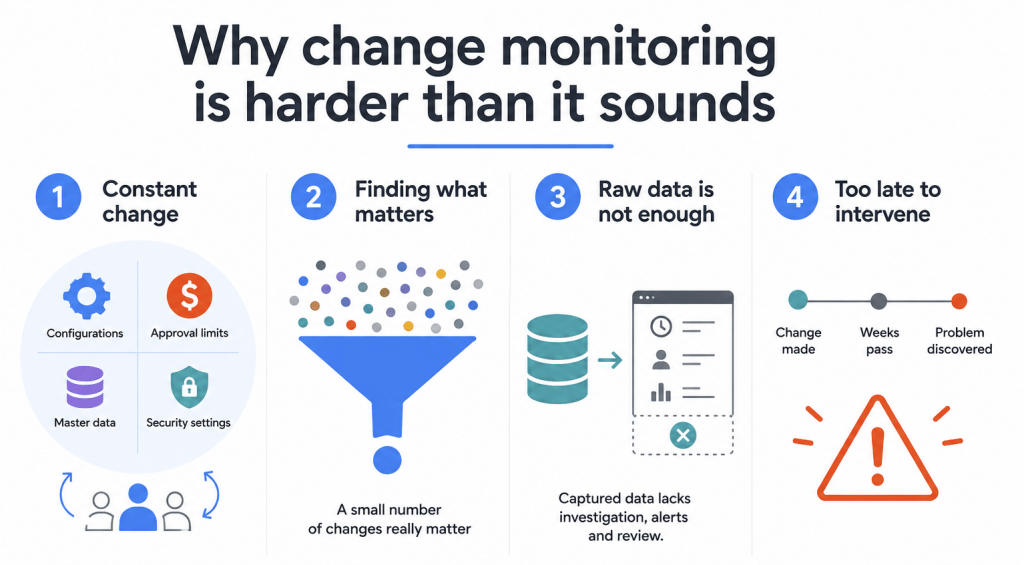
Oracle EBS changes constantly. Configurations are adjusted, approval limits are changed, master data is updated, and security settings are reconfigured. Somewhere within that constant stream sits a much smaller set of changes that genuinely matter, and that you need to know about as they happen.
Finding those changes is the hard part. EBS contains tens of thousands of tables. Monitor too little and you risk missing the change that mattered. Try to monitor everything without an effective way to manage the results, and you can quickly drown in noise, which in practice means nobody looks at any of it.
Oracle EBS includes native auditing, but turning it into a practical monitoring control is far from straightforward. Configuration can be cumbersome, and organizations are largely left to decide for themselves what should be monitored and how it should be set up.
The limitations of native auditing become even more apparent once the data has been captured. On-screen investigation is limited, meaningful off-screen reporting often requires additional technical work, and there is no built-in real-time notification framework to alert the right people when a critical change occurs. There is also no documentary review and approval mechanism through which a change can be investigated, explained, approved, and retained as part of the audit record.
Native EBS auditing can capture the raw change data. Turning that data into a timely, usable, and defensible monitoring process is another matter entirely.
Here is a concrete example. Someone quietly lowers a payment approval limit or edits a key financial setup, and nobody notices until the change causes a problem weeks later. By then, reconstructing who changed what and when can be difficult, the evidence may be incomplete, and the opportunity to intervene has already passed.
Why It Matters Right Now
There are two separate reasons to care about this, and they are both real.
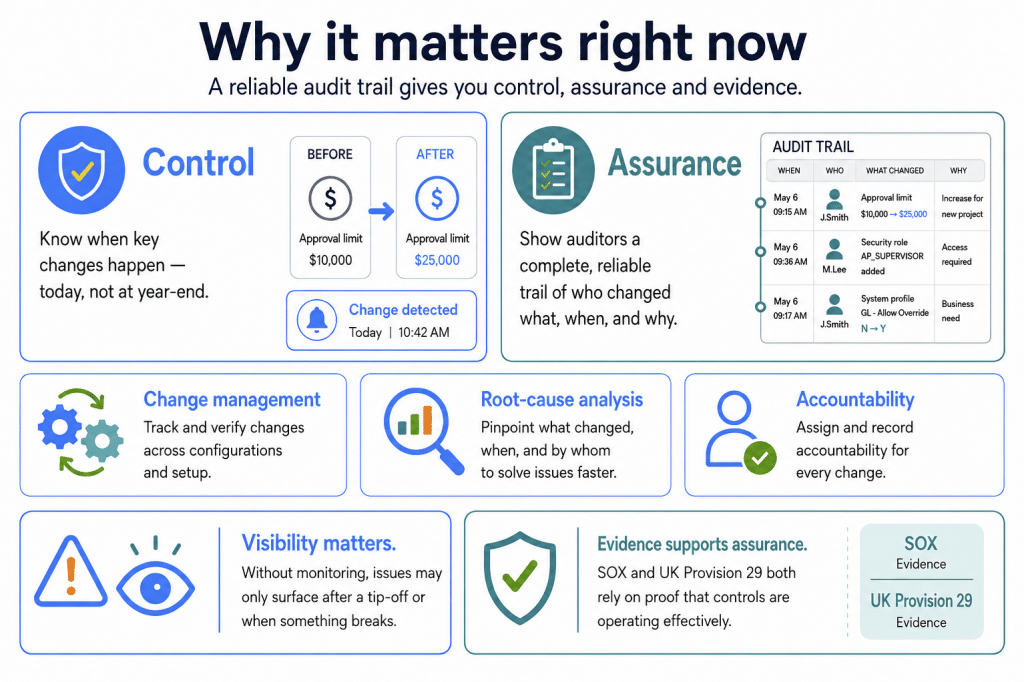
The first is control: if someone changes an approval limit or a security setting, you want to know today, not months later at year-end.
The second is assurance: when an auditor asks how you know a configuration was not quietly changed or tampered with, a complete and reliable trail is one of the strongest answers you can provide.
There is a broader, everyday benefit too, and it has nothing to do with catching bad actors. Most change in EBS is not malicious; it is simply change: a misconfigured setting, an unintended update, or an alteration with a knock-on effect nobody anticipated.
A reliable audit trail is one of the foundations of good change management. It gives you a clear history to work from when something breaks, makes root-cause analysis faster because you are not guessing what changed, and builds accountability into every change, not only the obviously risky ones.
For organizations in scope of SOX or the UK Corporate Governance Code, the underlying challenge is not simply to describe the relevant controls, but to support assessments of whether those controls are operating effectively. Where material financial, security, or configuration controls depend on activity within Oracle EBS, a reliable audit trail can provide valuable evidence of what changed, when it changed, and who made the change.
It is also worth considering how fraud is detected in practice. The Association of Certified Fraud Examiners’ 2026 global study found that tips remained the most common initial detection method, accounting for 43% of occupational fraud cases, more than three times the rate of any other method.
That is not an argument against monitoring. It demonstrates how much can still depend on an employee, customer, or supplier noticing something and choosing to report it when an organization lacks effective visibility into its own activity.
How CS Audit Helps
This is exactly what CS Audit is built for.
It is policy-driven: you select the areas and data that matter to your organization using what CS Audit calls Entities.
Because monitoring takes place at database level, CS Audit can detect changes to monitored data even when they do not originate from the particular EBS screen normally used to maintain it. It is primarily designed around activity performed through Oracle EBS, where the relevant application-user context and supporting details can be captured most completely.
It records who made the change, when it happened, and what changed, including a complete before-and-after picture, and it can also capture the reason for the change. It includes more than 400 predefined audit policies, so you are not starting from a blank page, and it can raise real-time notifications when critical or unusual changes occur.
It is also important to be clear about the role CS Audit plays. In the same way that CS Comply’s preventive controls can stop risky access before it is granted, CS Audit’s role is different: it is a detective control, not a preventive one.
It will not stop a change from happening. What it provides is rapid visibility into monitored changes, together with a defensible record of what took place. That combination, prevention where it belongs and a reliable and effective audit trail for everything else, is what a genuinely well-controlled EBS environment needs.
Next in this series, we will close the loop with the third question: do they still need it? Access that was appropriate a year ago has a habit of remaining in place long after the business need has disappeared.
Curious what an unmonitored area of your EBS environment might be hiding? Get in touch with Steve Davis at steve.davis@caosys.com, or schedule a live demonstration here.