The title of this article will no doubt bring a few obvious examples to mind, but let’s not focus on the irrational world in which we live, we have more important things to consider.
Whilst there is nothing I can do personally to alter the worldwide dynamic, I often find myself asking the same question when it comes to the purchasing processes related to risk management.
To be clear, we are in the business of governance, risk and compliance so it is our job to sell risk management solutions. However, we sometimes find ourselves sharing the frustration of a customer or prospect when they have found a way to deliver positive change on that front, only to find it comes to nothing.
Unarguably, the world in which we do business is not only heavily regulated by just about every country in the world, either through SOX type regulations or those defined by the IFRS (International Financial Reporting Standards), but it is also strictly audited to ensure adherence to those regulations for the financial security of companies and their shareholders.
In a lot of cases, these regulations are legislated and not just guidance, for instance SOX is defined by law in the USA but the UK Governance Code (UKSOX) is only guidance issued by the FCA (Financial Conduct Authority). That said, rest assured, if a listed company in the UK does not report on the “….. effectiveness of the [risk management and internal control] framework”, in line with UKSOX requirements, there could be a potential knock-on effect to its share price. Something that any company Board will be keen to avoid at all costs.
So, after putting together a compelling business case that will improve the way in which a company responds to compliance management, why is it that the business case is not eagerly adopted rather than rejected due to a lack of funding.
In all cases, a risk management, or audit related, business case is predicated on the basis that it will save money whilst improving processes. This in turn gives a company better internal reporting on its risk management, delivers easier internal and external auditing and greater insight regarding compliance at Board level.
But could it be that simple mathematics becomes an overriding factor, with a view that funding the business case would equal ‘X’ and there is no money in the budget specifically for ‘X’. Come back another day.
It seems that rarely is there a moment’s thought that, for example, if it costs £40,000 every year to go through an audit and if you adopted better methods and processes to cut that time in half, you are saving £20,000 a year. If it costs £15,000 to implement better methods and processes, you have already saved £5,000 in the first year. Year two then becomes a massive saving. So, you get to save money, implement better methods and processes and cut your auditing time in half. Therefore, does common sense not scream that the decision to find the funding for said business case has to be a YES!
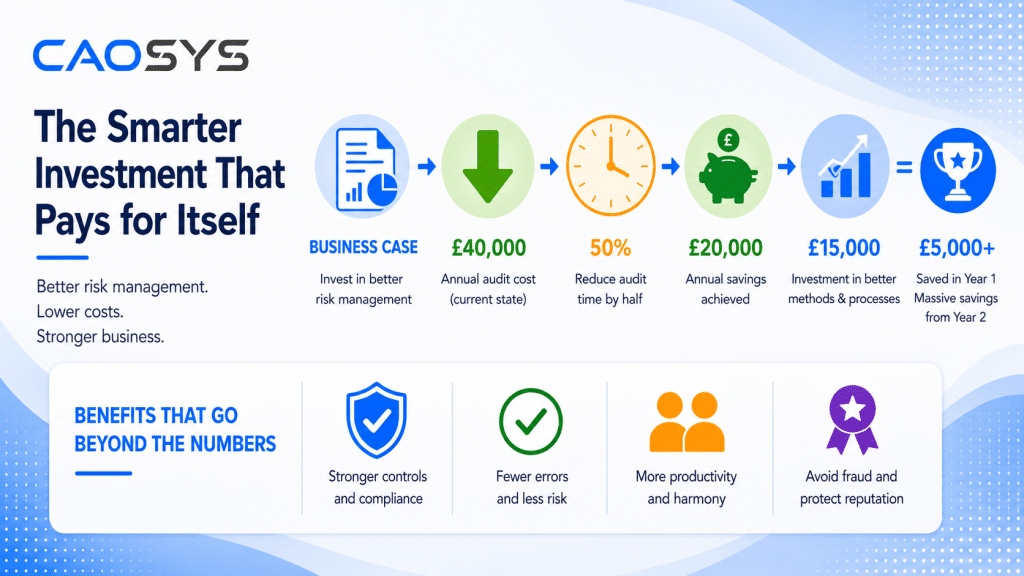
There are plenty of case studies that show that getting the right internal control framework in place means the right people, do the right jobs with the proper safeguards in place to ensure efficiency throughout the business. That efficiency translates to greater productivity, fewer errors, harmony in the workplace and, dare I say it, the avoidance of fraud which can cost a business not just huge amounts of money but reputational loss too. All that results in benefits to the business as a whole and a positive effect on the balance sheet. Not just saving money but making money!
So, the question is, when the advantages are so obvious, do decisions get put back or dropped entirely. Again, could it be that whilst risk management is clear to understand from a CISO or security officer point of view, when it comes to the wider business it is seen as a tedious task required merely to appease auditors. Of course, that should be different at Board level, but then the Board has a myriad of things to consider, compliance and successful audits are just another item on the list to be ticked; irrelevant of how it is achieved.
It is always refreshing when you start dealing with someone and they just ‘get it’. It then becomes a real pleasure helping them build the business case, with real reasons why it is worth the investment. It is then excellent when the management team understand the ‘why’ and the overall benefit that can be delivered to the business. And they get the point that there is no time like the present to turn that vision into reality and they begin looking at budgets to see where funding can be found.
However, insanity has the ability to trump common sense, and make finding budget for a good cause too much like hard work and then there just isn’t the time. Better to shelve it to another day, even if there is clear evidence that implementation would release money from other budgets. And that leaves many a champion very frustrated.
Ask a CISO or a security office how important it is to have an effective risk management framework, ask any auditor if they would love to spend less time on each of their audits (yes, it’s true!), ask IT if they would appreciate spending less time producing endless audit reports, ask the business if they would like to feel confident that their processes and procedures are as robust as possible. All would come back with a very big YES.
So, if you are tasked with finding some budget for a risk management business case that demonstrates clear advantages to your company, don’t just push it to one side or chuck it in the pending tray, let common sense rule, become a hero and find the budget. There will be a long line of people thanking you for making their jobs easier and an even longer line of stakeholders in the business thanking you for your vision.