Staying in control of Oracle EBS
The three questions every controls team has to answer
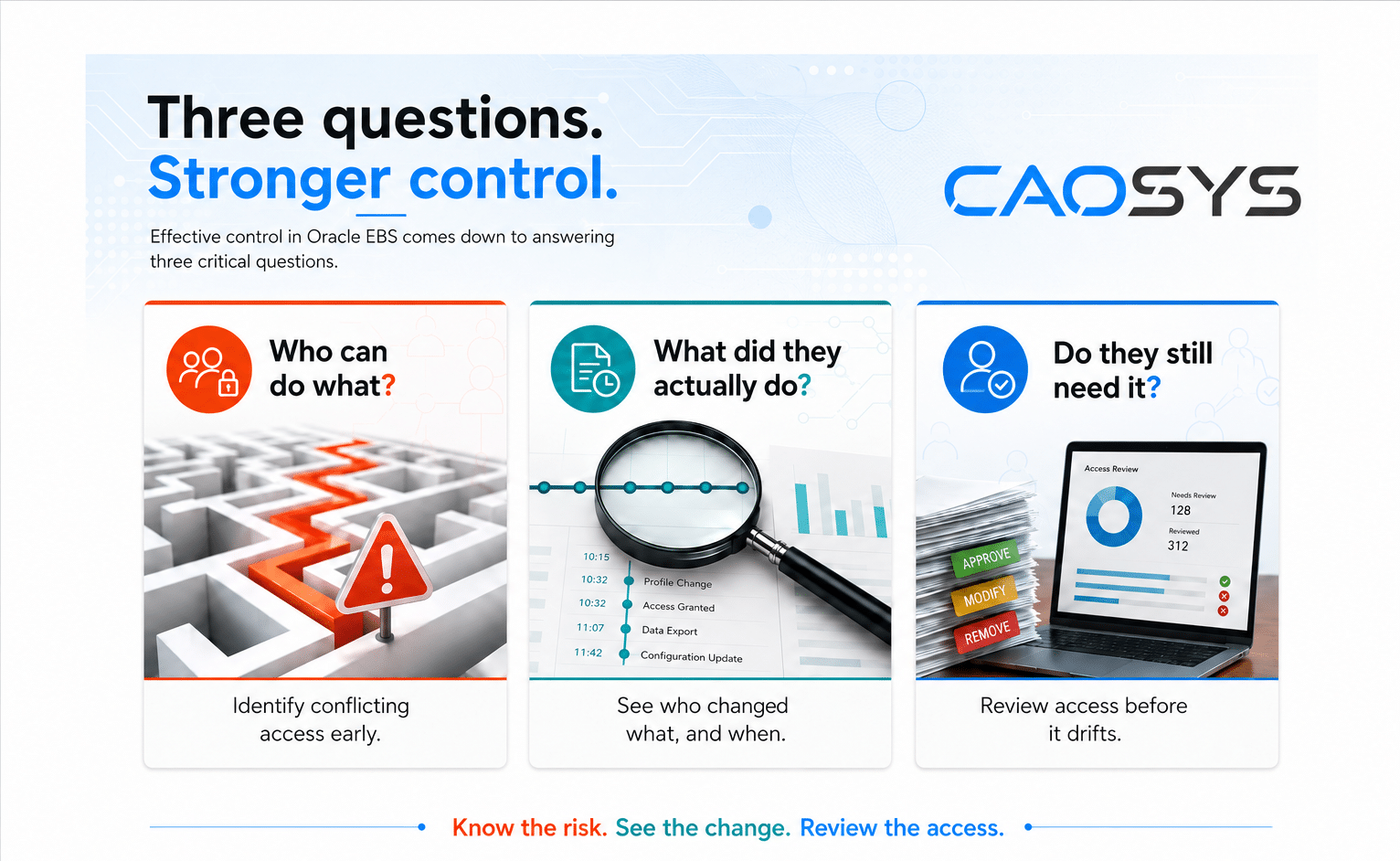
If you’re responsible for controls in Oracle E-Business Suite, most of the job comes down to answering three questions, both to yourself and to your auditors…
- Who can do what?
- What did they actually do?
- Do they still need it?
Each one is easy to ask. In a real EBS environment, each one is surprisingly hard to answer by hand.
Consider what sits behind the first question. Users hold responsibilities, responsibilities grant menus and functions, and those combine into a very large number of access points. Layer segregation-of-duties rules on top, checking (for instance) that no one can both create a supplier and pay an invoice, and the number of individual checks runs into the millions (often billions). No team works through that on a spreadsheet. The same volume problem shows up in the other two questions. Change happens constantly across tens of thousands of tables, and access that was appropriate last year quietly drifts out of date as people move roles.
This is why the questions matter beyond good housekeeping. Regulation gives them teeth. In the US, Sarbanes-Oxley has long required companies to maintain and demonstrate effective internal controls over financial reporting, segregation of duties and access reviews among them. In the UK, the Corporate Governance Code’s Provision 29, often called “UK SOX,” asks boards to review their controls and make an annual declaration on their effectiveness, with the first cycle landing in 2026. Different regimes, same underlying demand: evidence that your controls work, not just a statement that they do.
There’s a second reason to think about where you answer these questions. Oracle EBS is a long-lived platform. Oracle has committed Premier Support for EBS 12.2 through at least 2037, so many organizations running it today will be running it for well over a decade. Yet Oracle’s own GRC tooling for EBS has wound down. Those products are now in sustaining support, with Severity 1 fixes provided only through May 2025 (both per Oracle’s own notices). That leaves a long-lived platform with a gap where its native controls used to be.
CAOSYS fills that gap from inside EBS. Where most vendors now require you to move your data into their cloud, our integrated suite is among the very few that install directly into Oracle E-Business Suite, so you answer these questions where the data already lives, with no migration. (We also offer a 100% cloud platform for organizations that want it, but that’s a separate story.)
Three questions, one integrated suite
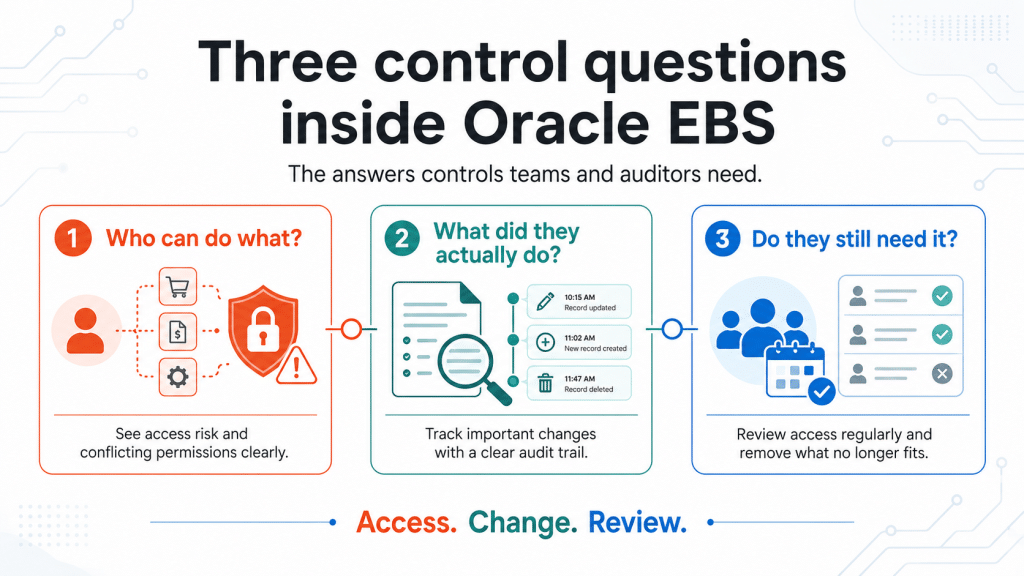
Who can do what?
CS Comply – Analyzes segregation-of-duties and sensitive-access risk across your EBS applications, using a rules engine that scans exceptionally fast.
What did they actually do?
CS Audit – Captures change as it happens, recording the who, when, what, and why, with a full before-and-after picture.
Do they still need it?
CS Provisum PAR – Automates user access reviews (UARs) end to end, and can close the loop by de-provisioning what’s no longer needed.
We’ll take each one in turn over the next three posts in this series, alongside a companion piece on getting operational data out of EBS with CS Report. Start wherever your most pressing question is.
Want to talk through which of these three questions is hardest for your team right now? Get in touch with Steve Davis at steve.davis@caosys.com, or schedule a live demonstration here.