Do They Still Need It? User Access Reviews in Oracle EBS
This is the third question in our series, and it closes the loop. The first two asked who can do what (access risk) and what did they actually do (auditing change). This one asks something quieter, and easy to put off: is the access people already hold still appropriate?
That question is the heart of the user access review, commonly called a UAR. It is usually where auditors expect to see a regular, documented, closed-out process, and it is usually where the wheels come off.
Why Access Drifts Out of Date
The problem with access is that it accumulates. It is granted correctly on day one, and then the world moves on around it.
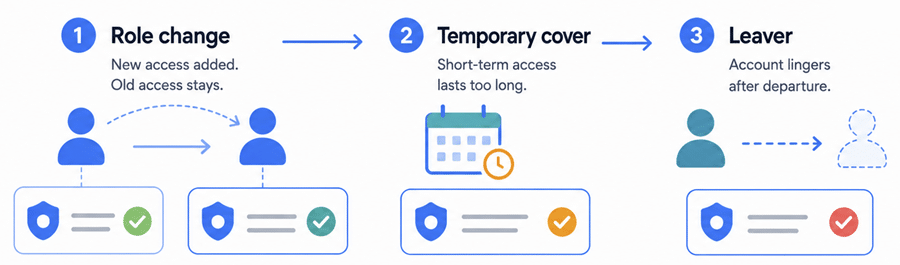
Someone changes teams and picks up new access, but nobody removes the old. Someone covers a role for three months, and the access outlives the cover by three years. Someone leaves, and an account lingers. None of this is dramatic, and none of it is malicious. It is just the natural drift of a live organization, and left unchecked it means a growing number of people hold access they no longer have any reason to have.
Movers are the hard case. Adding new access when someone changes role is easy and usually remembered. Removing the access they no longer need is the step that gets forgotten, and a person who keeps every role they have ever held is exactly how access creep begins.
Why It Matters
A user access review is the control that catches this drift. Done properly, the right people confirm that each person’s access is still justified, and anything no longer needed is removed and evidenced.
It matters for the same reason the first two questions do: regulators expect it. Periodic access review is a long-standing expectation under SOX, and it fits squarely inside the ongoing-monitoring emphasis of the UK’s Provision 29, with its first cycle in 2026. “We review access once a year” is not enough on its own. An auditor wants to see who reviewed what, when, what was removed as a result, and the dated trail that proves it happened.
Why It Is Harder Than It Sounds
On paper, a review is simple: send each manager a list, ask them to confirm it, remove what they reject. In practice, a manual review is a long, awkward process, and it breaks down at almost every stage.
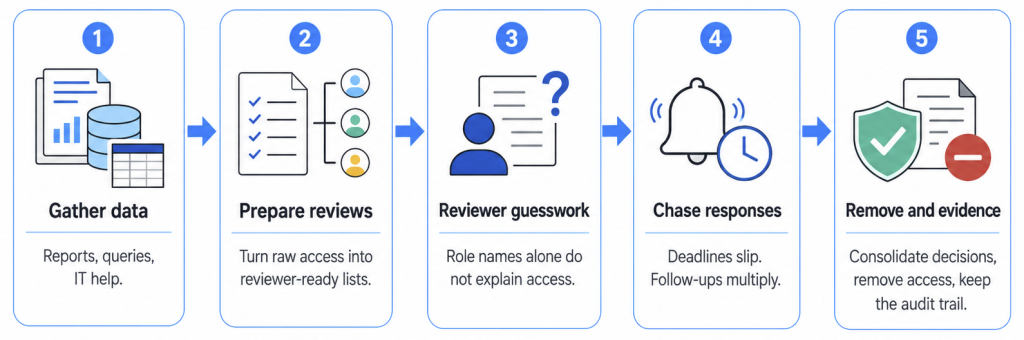
It starts before the review even begins, with just gathering the information. The access data exists, but getting it into a shape a review can actually use is another matter. It often means running several different reports, writing ad-hoc queries, or waiting on IT to pull it together. Then that raw access data has to be broken down into meaningful chunks, the right slice of access in front of the right reviewer, which is fiddly work in its own right before anything has been sent anywhere.
Then there is the reviewer problem: even once they have their list, reviewers are often guessing. They are handed a set of responsibility (role) names and asked whether each person still needs them, with little to go on but the name. Most line managers cannot say what a given EBS responsibility (role) actually permits, so they approve the whole list rather than admit they are unsure. A review that rubber-stamps everything is a formality dressed up as a control.
Then there are the logistics of distribution. Getting all of that information out to all of the right reviewers, in a form each can actually work with, is a genuine administrative burden, and it repeats every cycle, for a review that should happen regularly rather than once a year in a panic.
Then comes the chasing. Reviewers are busy, deadlines slip, and someone has to keep track of who has responded and who has not, then chase the stragglers. It is time-consuming, thankless, and it is usually a person’s job to do it by hand.
And finally, once the responses are back, it all has to be pulled together: consolidating every reviewer’s decisions, presenting the rejected access for removal, and keeping a clean, dated record of the whole exercise for the auditor. Even then the removal step often depends on a manual hand-off back to the security team, and that hand-off is a common place for things to stall. Flagged access lingers long after the review said it should go. A review that identifies unneeded access but does not reliably remove it has not actually controlled anything.
How Often Is Often Enough?
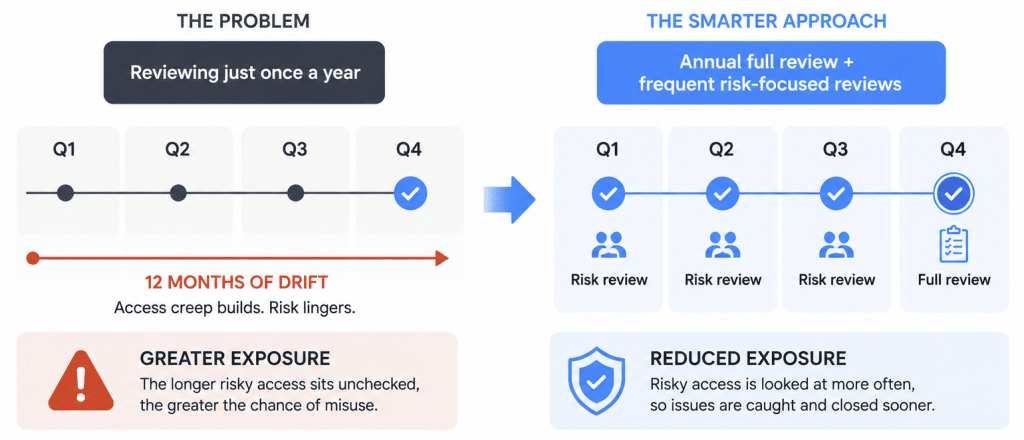
All of that administrative overhead has a knock-on effect: because a full review is such a burden to run, many organizations end up doing it as rarely as they can get away with, often just once a year.
That is a problem for two reasons. The obvious one is access creep: a lot can happen in twelve months, and a year’s worth of movers and role changes can quietly pile up before anyone looks. The bigger one is exposure. If inappropriate access sits unchecked for up to a year, the window in which something can go wrong is a year wide. The longer risky access lingers, the greater the chance it is eventually misused.
For many organizations, the sensible answer is not simply to review more often, since a full-population review is too heavy to run every month. It is to review more intelligently. Run the full user population review annually, as you always have, but layer more focused, risk-driven reviews on top of it, run more frequently and aimed squarely at the access that actually carries risk. The routine full sweep still happens; the genuinely dangerous access gets looked at far more often than once a year.
How CS Provisum PAR Helps
This is what CS Provisum PAR is built for. It automates the full user access review cycle: it initiates the review, gathers the information reviewers need, and, when CS Comply is licensed, puts the actual SoD and sensitive-access risk right in front of reviewers so they are deciding on real information rather than a bare list of names.
It supports different reviewer types, so the right person certifies the right thing: process owners, supervisors, and more. It runs multiple reviews concurrently for different parts of the business, and sends automatic reminders with escalation so deadlines are not quietly missed.
Two capabilities are worth calling out, and together they are what make the annual-plus-frequent cadence above realistic rather than aspirational. First, you can scope a review by risk: rather than reviewing everything, you can run a review that includes only the access CS Comply has flagged as risky, focusing reviewer effort exactly where it counts. That is precisely what a frequent, risk-driven review needs, and because it runs multiple reviews concurrently, the focused risk reviews can run alongside the annual full sweep rather than competing with it. Second, and most importantly, it closes the loop. Any deprovisioning after the review can be fully automated, with no manual hand-off back to the security team. The step that manual processes so often drop is the one CS Provisum PAR does automatically.
That last point is the difference between a review that produces a report and a review that produces a result.
This also completes the picture the three questions set out to answer. Control who can do what, prove what changed, and confirm people still need what they hold. Each question stands on its own, but answered together, and from inside EBS, they add up to a genuinely well-controlled environment.
Want to see how much faster a risk-scoped review could be in your EBS environment? Get in touch with Steve Davis at steve.davis@caosys.com, or schedule a live demonstration here.
Here are the other posts in this series…
Oracle EBS Controls: Three Questions to Answer